
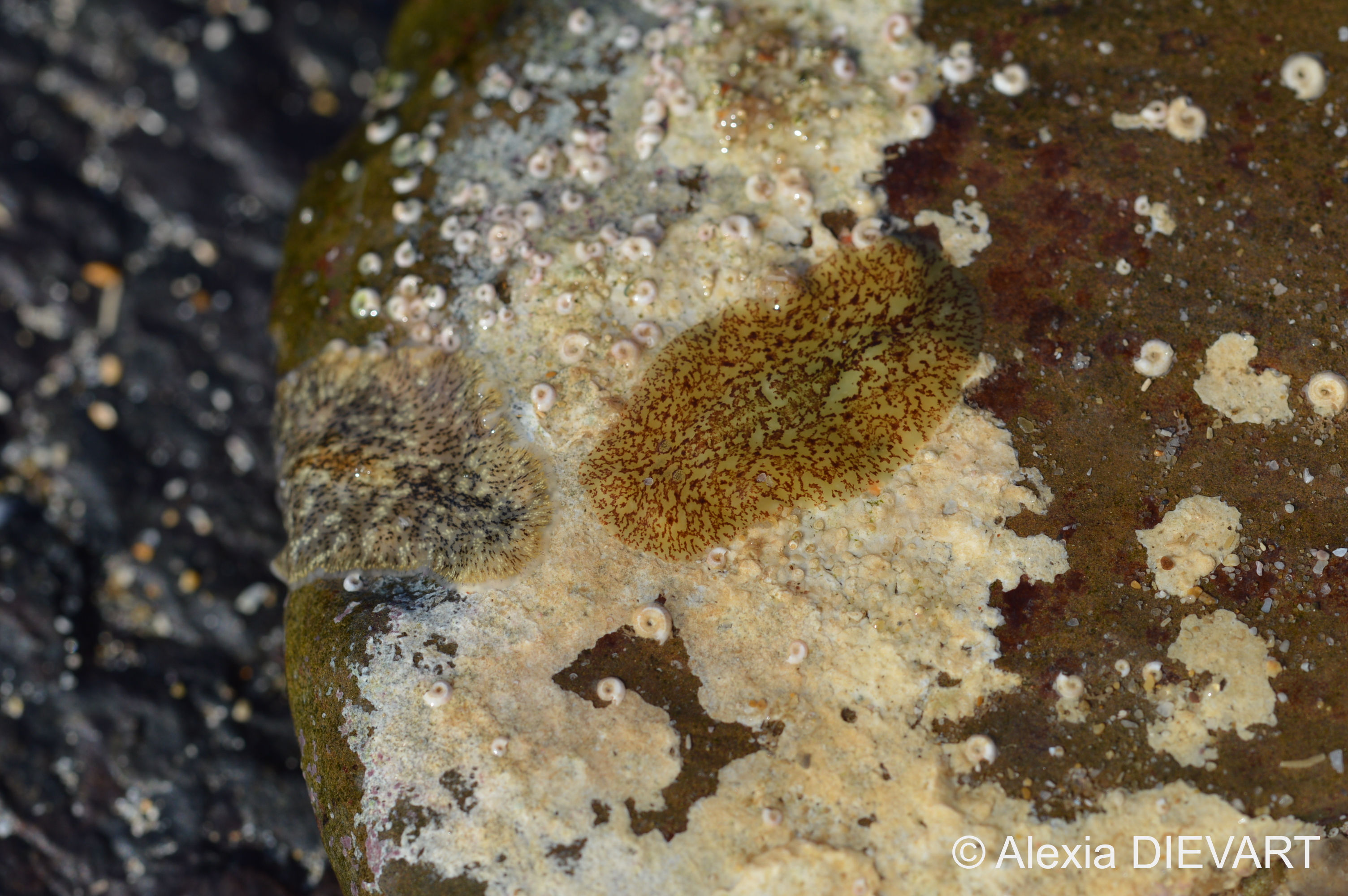
Also referred to as Gilchrist’s flatworm or the spotted flatworm.
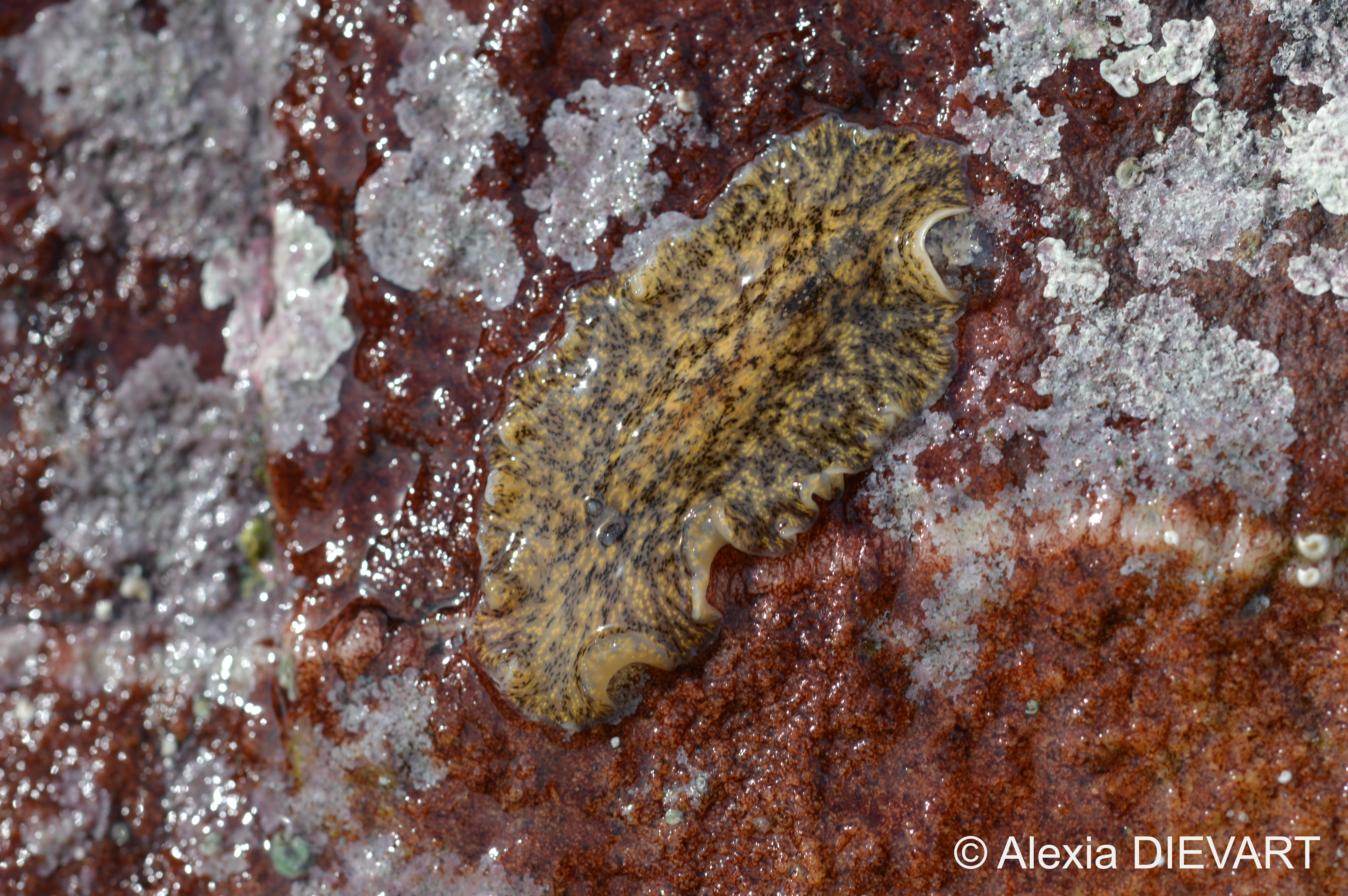
Body broadly oval, both ends being similarly rounded. Margin of the body ‘frilly’ (strongly folded) but dorsal surface smooth. Fairly firm consistency and very little transparent.
Mottled brown in color, with irregular black speckles grouped together in small heaps equally distributed over the dorsal surface and forming a continuous black line only in the dorsal middle line, in the region of the reproductive organs.
Two high pointed ‘neck-tentacles’ towards the front end. Each tentacle has, at its base, 15 – 20 large, well-developed eyes that can be distinguished under the microscope.Between 20 and 30 mm in length, and a maximum diameter of 7 cm.
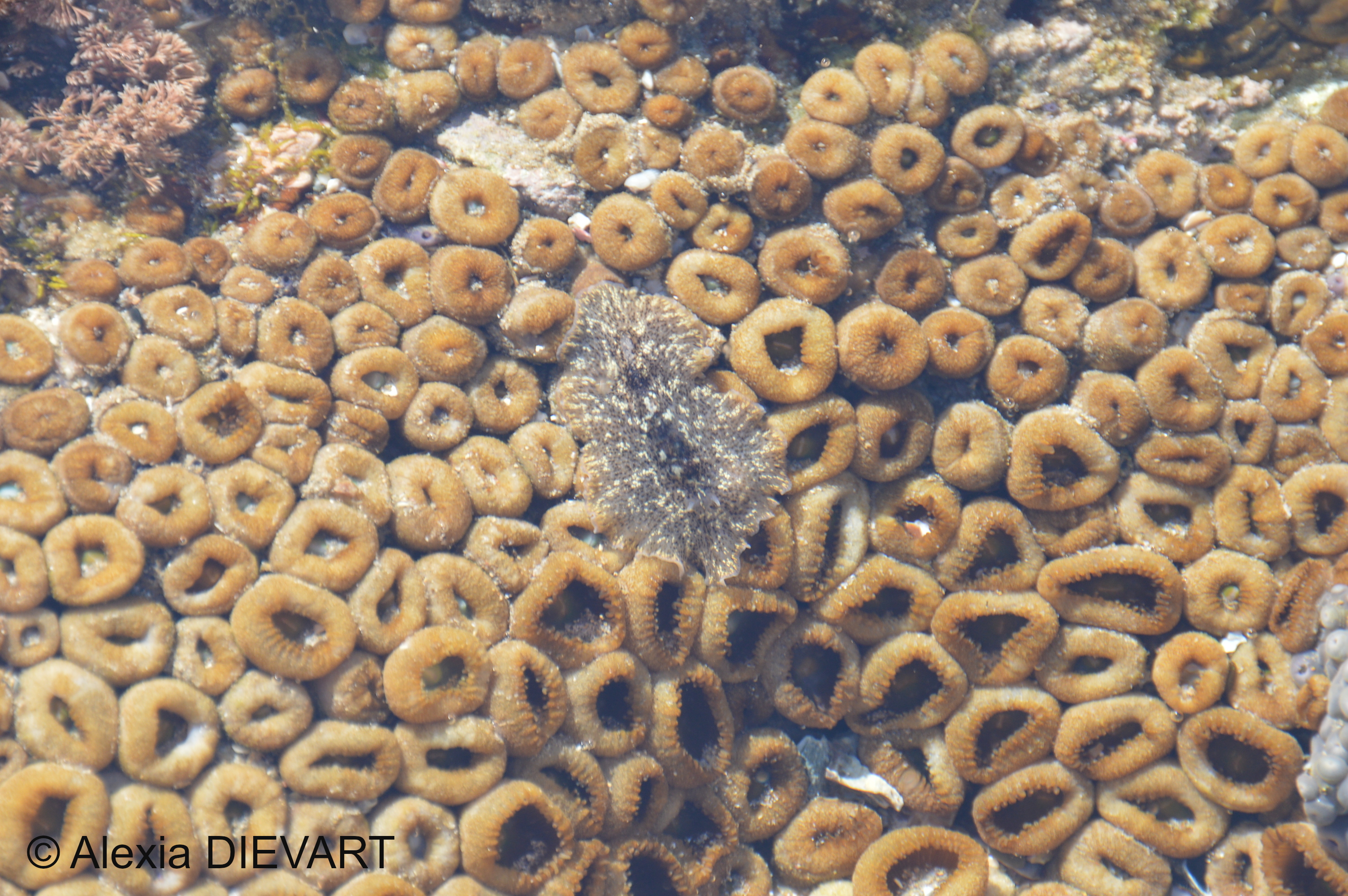
A predator of worms, small crustaceans and mollusks. Found under boulders near low tide.
Two Oceans: A Guide to the Marine Life of Southern Africa (1994), Jacubowa (1907).
Discover in Video
Discover in Image
Feeding behaviour
Planocera gilchristi follows a clear and identifiable motor pattern when it comes to the capture of prey (Koopowitz, 1970) :

- Prey recognition. The frilly margin of flatworm has to come into contact with either the body or the shell of the prey to initiate the capture. In a laboratory experiment, it rejected empty dried shells and shells from which the snails had been extracted, and was unable to follow the mucus trails of the snails or to recognize an animal moving a few millimetres away.
- Orientation to the prey. Once the prey recognized, the front end of the warm lifts up and twists in the direction of the prey, attempting to make contact.
- Prey stalking. The flatworm follows the prey if it is trying to escape, gliding above the substrate and overtaking it to achieve capture.
- Prey capture. Once the prey is overtook, the flatworm clamps onto the shell with its front end, while its posterior end adheres to the substrate. The progression of the prey is halted. Although the snail may try to throw of the flatworm by rapidly twisting its shell side to side, the flatworm’s flexibility allows it to maintain its grip on both shell and substrate. At this stage, the prey usually withdraws into its shell as a last attempt to survive.
- Feeding position. Two patterns can be observed : (1) the flatworm releases its front end and move forward over the prey, until the worm’s mouth is positioned over the shell, and (2) the flatworm overturn the prey through a rapid contraction of its longitudinal muscles, then releases its front end and slide to position its mouth over the aperture of the snail.
- Prey carrying. The flatworm can start feeding instantly, or delay feeding and carry its prey around. In the latter case, the margins of the animal extend beneath the prey and lift it off the substrate. Large flatworms will even try to swim, carrying the prey away.
- Extraction. Depending on the position of the prey, two sequences can occur : (1) if the snail is not turned over, the flatworm everts its pharynx down into the snail operculum – in an attempt to turn the snail over – and then slides towards the snail aperture before extracting it from the shell by a slow contraction of the parapharyngeal musculature, with raises the worm’s body off the shell into a characteristic humping position, and (2) if the snail is turned over, the flatworm only has to extract it.
- Swallowing. When the snail is being extracted from its shell, the folds of the flatworm’s pharynx cover the prey up to the region of the digestive gland. Once the snail is out, the pharyngeal folds move down, engulfing the entire prey, which is drawn into the mouth.
While a flatworm is feeding, it will ignore other potential prey and will usually not feed for another 2 – 3 days. After 24 hours of a meal, the undigested parts of the prey (e.g., material from the digestive gland, columella muscle) are expulsed through the mouth. Finally, the flatworm’s prey appear to be narcotized.
REFERENCES
Jacubowa, L., 1907. A new species of Planocera (P. gilchristi) from South Africa. Transactions of the South African Philosophical Society 17, 145–149. https://doi.org/10.1080/21560382.1907.9526086
Koopowitz, H., 1970. Feeding behaviour and the role of the brain in the polyclad flatworm, Planocera gilchristi. Animal Behaviour 18, 31–35. https://doi.org/10.1016/0003-3472(70)90066-7

 F*CK FISH