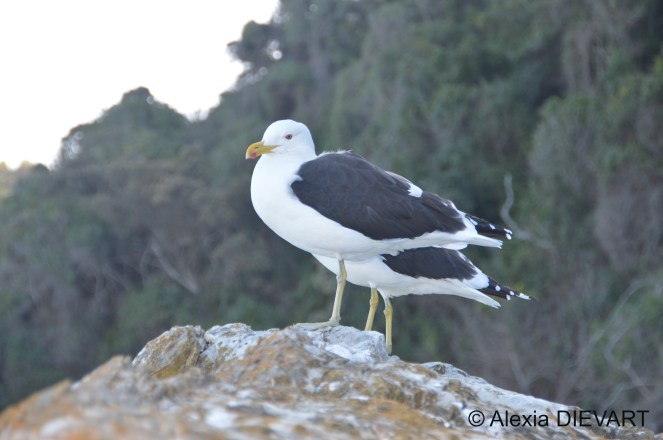
The largest gull in the region, also called the Dominican gull.
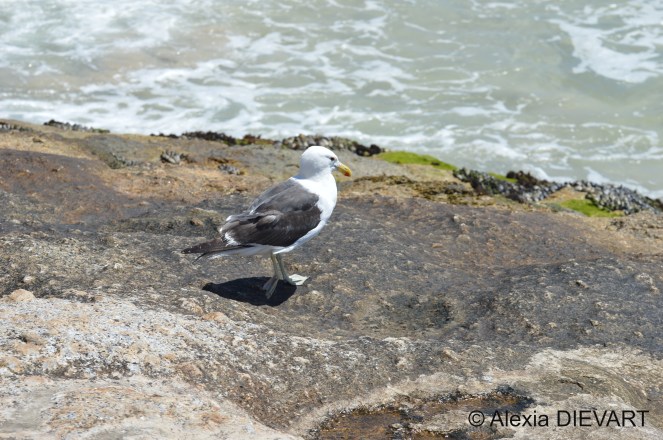
Heavily built, with relatively short wings (folded wings do not project well beyond the tail tip), a robust bill, a steep forehead, and typically olive-grey (not yellow) legs, although there is considerable variation in leg colour.
Adult is white, with jet-black back and upper wings, dark grey-brown eyes (rarely yellow or silver-grey) ringed with red, and a yellow bill with a red spot. Juvenile is heavily streaked dark brown, with a blackish bill and brownish-pink legs. Immature has a white body with diffuse brown smudging, a slate-grey mantle with some brown feathers, a blackish tail tip and pinkish bill at the base and tip. Sud-adult retains some brown in upper- and underwings and has a dark tail tip, and the bill sometimes has a dark subterminal mark. Young adult may retain the dark tips to outer-tail feathers and some diffuse, dusky streaking on the head and mantle.
About 55 – 65 cm, with a wingspan of 1.3 – 1.4 m. Weigh about 1 kg.
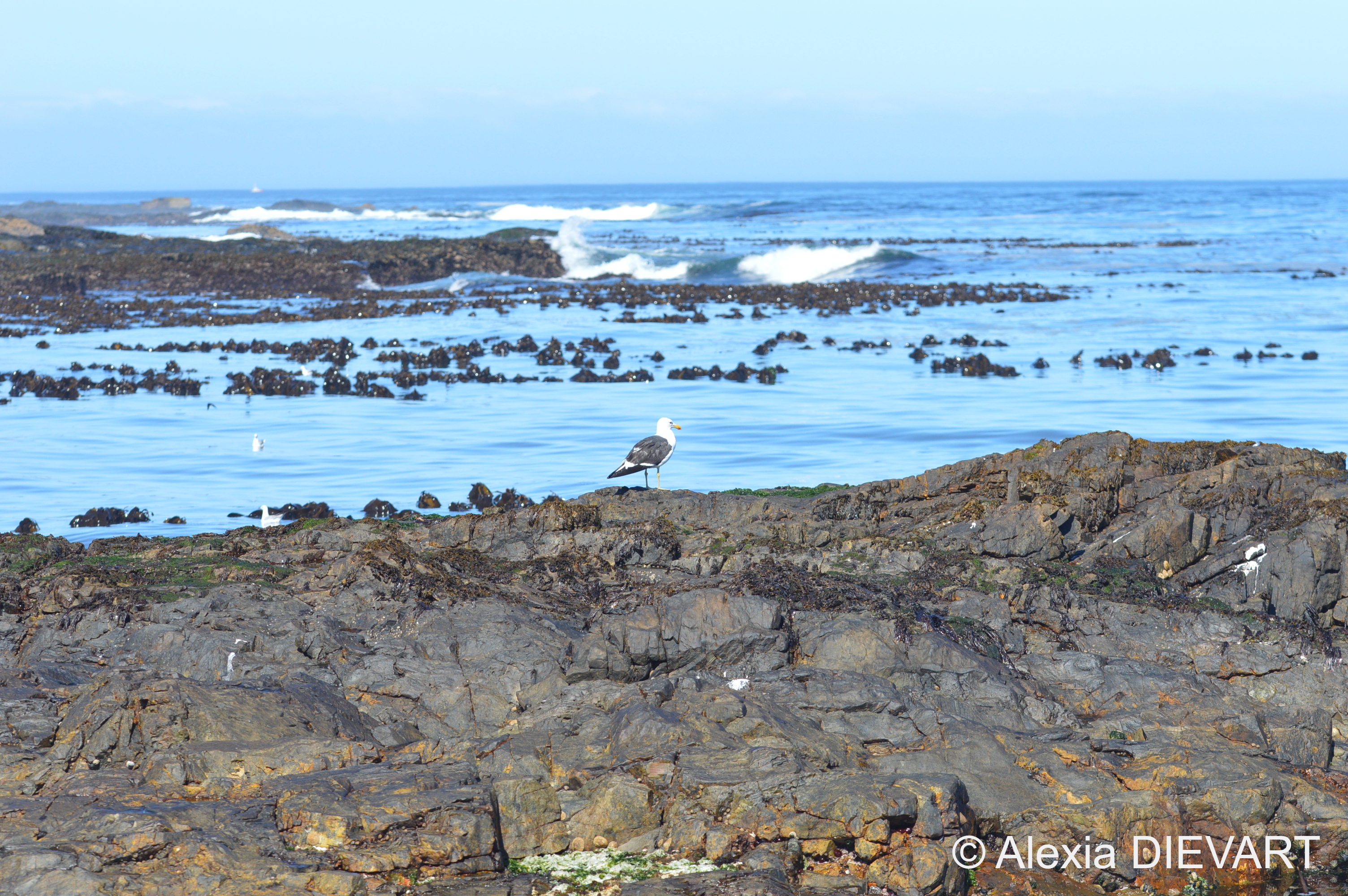
A common resident in coastal habitats and adjacent wetlands. Scavenges offal and animals cast up after storms, and follows trawlers up to 100 km from the shore. Collects stranded black mussels and smashes them by dropping them from the air onto rocks. Preys on white mussels (Donax serra) which it obtains by treadling in wet sand. Often eats the eggs or chicks of other island-breeding birds if they are distributed and move off their nests.
Two Oceans (2007), Birds of Southern Africa (2020).
Its numbers have increased in recent years because it scavenges food from rubbish dumps, and it is increasingly found on fields up to 50 km inland. Nests on coastal islands or cliffs, with about 20 000 pairs breeding in summer.
A matter of subspecies
Kelp gulls are so common around the world that they are divided into several subspecies depending on the location. In South Africa, Namibia and Southern Angola, Larus dominicanus subsp. vetula is endemic and sometimes considered a separate species – then referred to as Cape or Khoisan Gull – but there is recent gene flow from South America that blurs this distinction.
There are four other subspecies that breed in New Zealand, South America, Southern Madagascar, the islands of the Southern Ocean, and as far south as Antarctica.

 F*CK FISH