
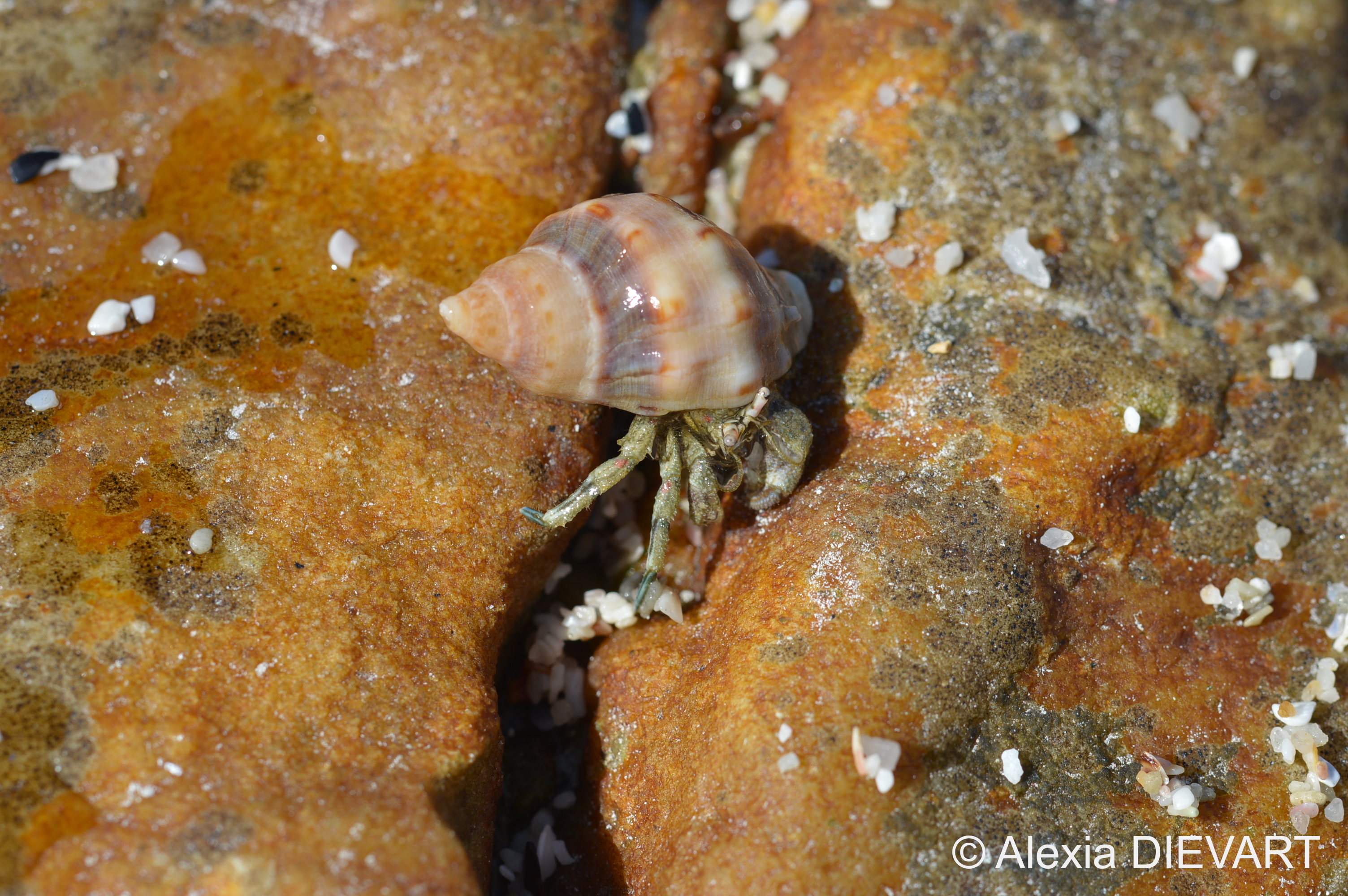
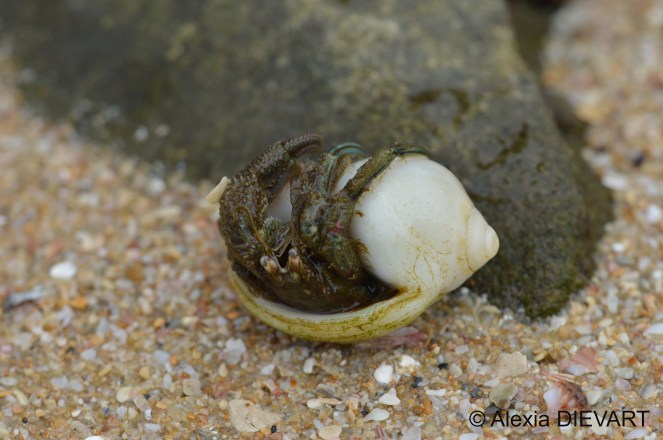
Body dirty-white with darker speckles and spines. Brown stripes on last segments of walking legs. Left nipper thorny and much larger than the right.
About 30 mm.
Endemic to South Africa. Extremely common on sheltered sandbanks and in sandy pools. Buries in sand when exposed by the tide, emerging when submerged to scavenge.
Two Oceans: A Guide to the Marine Life of Southern Africa (2007)
The commonest of four closely-related southern African Diogenes species.
Discover in Video
Discover in Image
Shell utilization and morphometrics
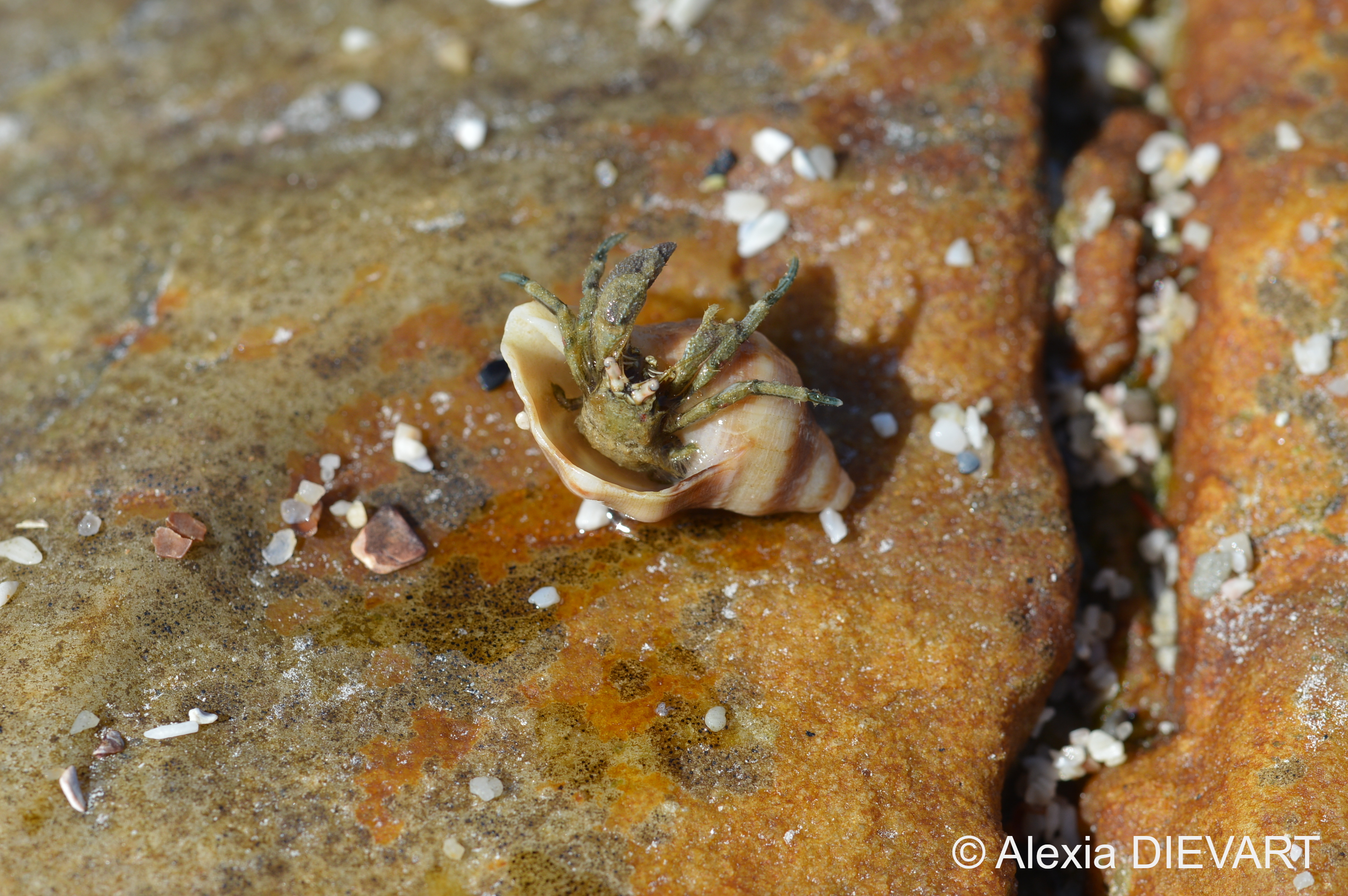
As hermit crabs grow and require larger shells, the availability of suitable empty gastropod shells in the environment is a limiting factor for the hermit crab population (Kellog, 1976). The sizes of shells occupied by hermit crabs in the field is almost always correlated with the hermit crab sizes, as the hermit crabs often proceed to ‘mutual gain’ shell exchange (Hazlett, 1983). Before entering an empty shell, Diogenes brevirostris will insert its larger chela – or nipper – into the aperture to assess the suitability of the shells, and check for unwanted shell inhabitants (Emmerson & Alexander, 1986). Once the hermit crab inhabits the desired shell, it can also use its larger chela as an ‘operculum’ to close the aperture of the shell in order to avoid predation and competition !
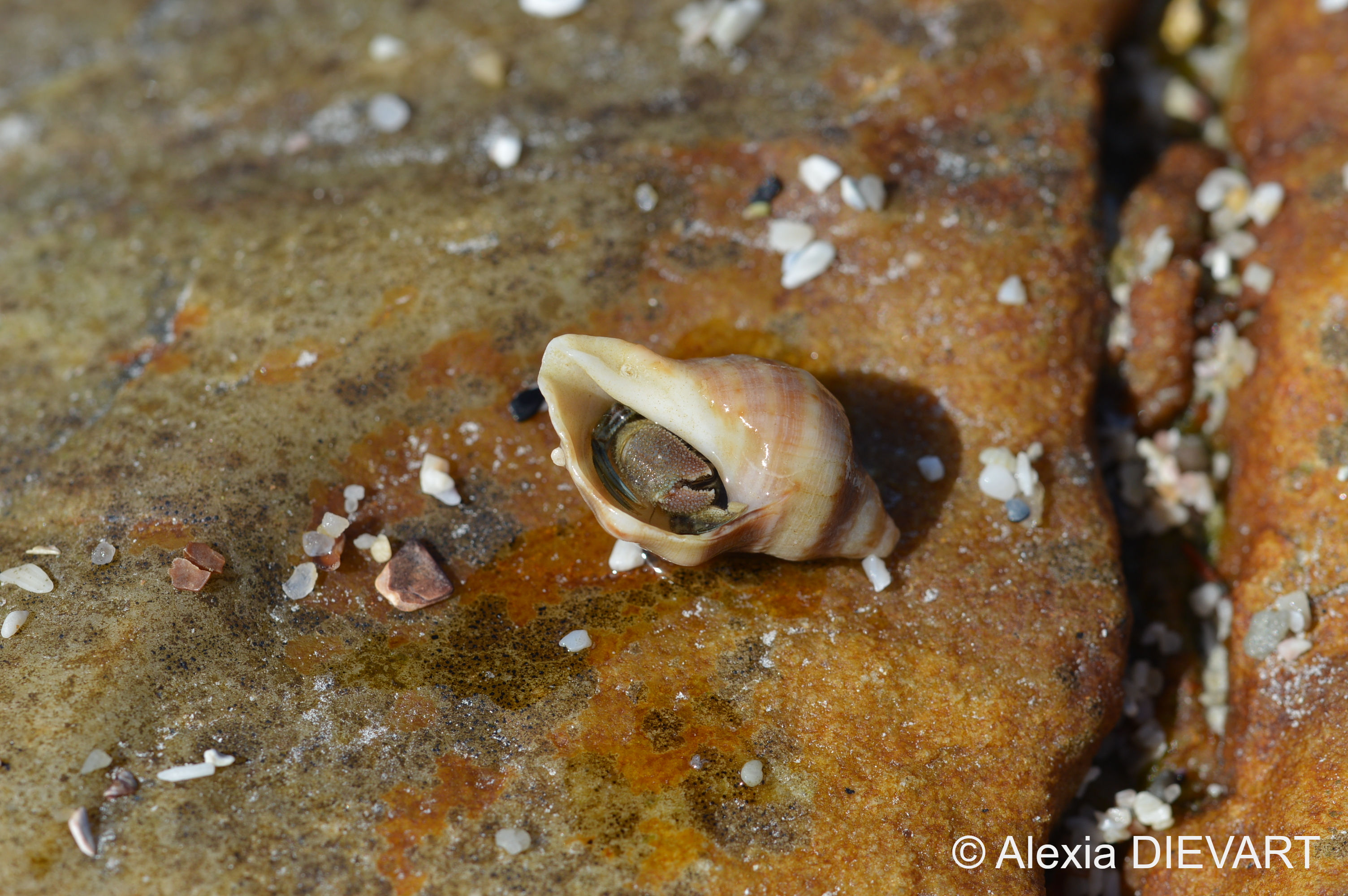
Diogenes brevirostris inhabit a large number of gastropod shell species. Emmerson & Alexander (1986) identified 33 gastropod shell species in a survey of the hermit crab population in the Eastern Cape, South Africa, of which Burnupena lagenaria and B. cincta were the most common, followed by Bullia sp. and Oxystele sinensis. Smaller hermit crabs occupy small gastropod shell species, such as Littorina knysnaensis. As D. brevirostris ranges from the West to the East coasts of South Africa, it is certain it occupies many more shell species, especially from the warmer waters of the East coast, particularly rich in molluscs (Kilburn & Rippey 1982).
Hermit crabs can used different shell species depending on the locality and the substrate (e.g., rocky vs sandy shore). Diogenes brevirostris predominantly select Burnupena shells on rocky shores, while Bullia is utilized more on sandy shores (Emmerson & Alexander, 1986). However, there is a drawback : there is more ‘dead space’ in a Bullia shell, because of its high spire, than in a Burnupena shell !
But not all shells are made equal ! Hermit crabs prefer a robust shell, and will avoid unsuitable shell shapes and small apertures. The pink-lipped topshell Oxystele sinensis is thinner than other shells, making it more susceptible to damage by waves, compared to Burnupena shells. Nerita albicillia is also common on the rocky shores, but avoided by hermit crabs die to its limpet-like shape. Conus shells are also disregarded because of the slit-like aperture, which does not allow a hermit crab to easily enter the shell.
Reproduction
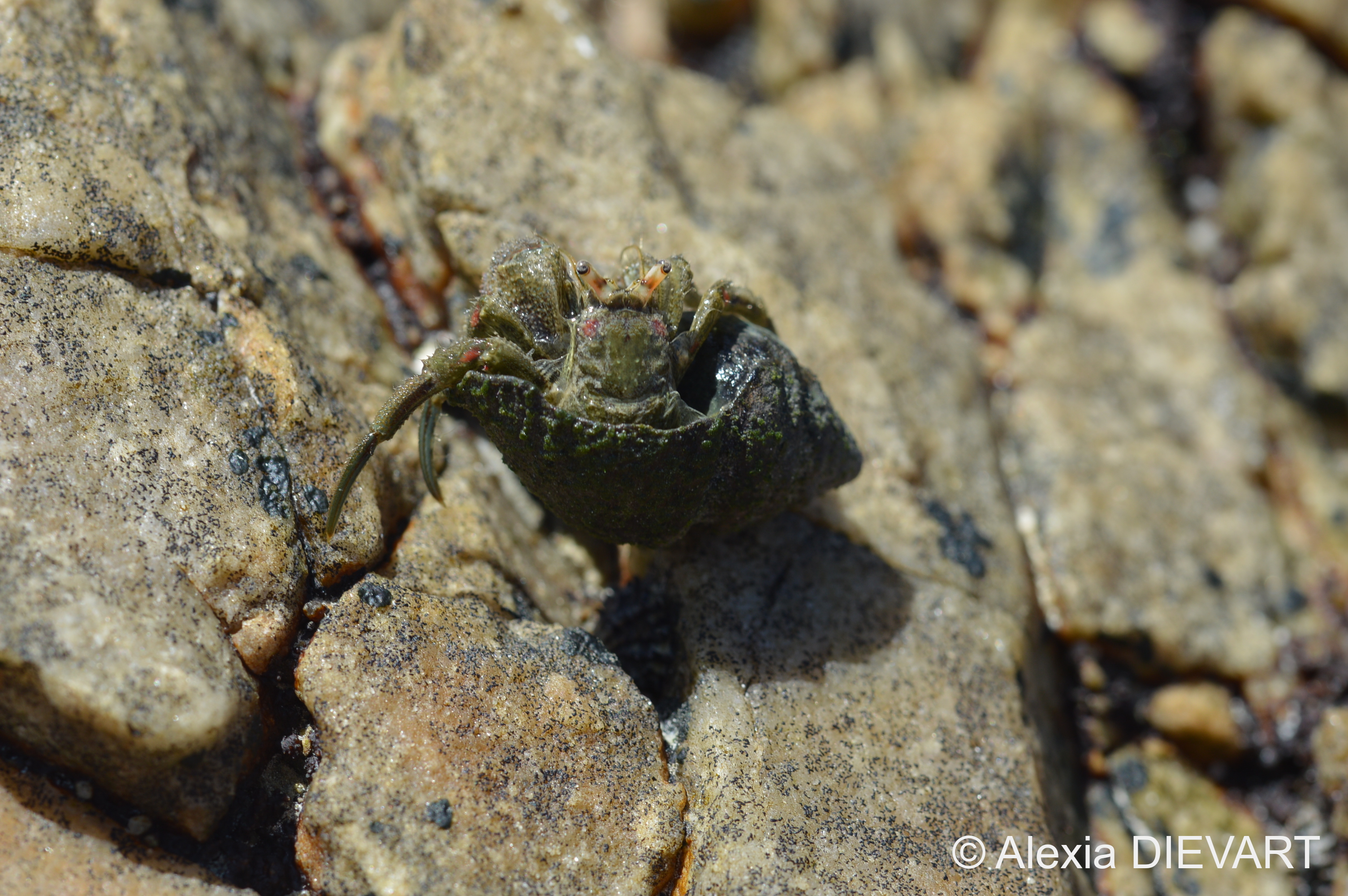
Compared to true crabs of similar sizes, the fecundity of Diogenes brevirostris is low due to the ovigerous pleopods – the legs carrying the eggs – being limited to just on side of the abdomen (Hazlett, 1981), and the limitation of shell volume (Bertness, 1981a). As a female ovigerous hermit crab, occupying a shell affords protection from predation and physical stress to the eggs (Hazlett, 1981). However, ovigerous female hermit crabs make poor competitors for shells if faced by males and non-ovigerous females (Bertness, 1981b). Ultimately, hermit crabs in smaller shells reproduce more often (Bertness, 1981a).
REFERENCES

Bertness, M.D., 1981a. Pattern and Plasticity in Tropical Hermit Crab Growth and Reproduction. The American Naturalist 117, 754–773.
Bertness, M.D., 1981b. Interference, exploitation, and sexual components of competition in a tropical hermit crab assemblage. Journal of Experimental Marine Biology and Ecology 49, 189–202. https://doi.org/10.1016/0022-0981(81)90070-8
Emmerson, W.D., Alexander, M.D., 1986. Shell utilization and morphometries of the hermit crab Diogenes brevirostris Stimpson. South African Journal of Zoology 21, 211–216. https://doi.org/10.1080/02541858.1986.11447984
Hazlett, B.A., 1983. Interspecific negotiations: Mutual gain in exchanges of a limiting resource. Animal Behaviour 31, 160–163. https://doi.org/10.1016/S0003-3472(83)80184-5
Hazlett, B.A., 1981. The Behavioral Ecology of Hermit Crabs. Annu. Rev. Ecol. Syst. 12, 1–22. https://doi.org/10.1146/annurev.es.12.110181.000245
Kellogg, C.W., 1976. Gastropod shells: A potentially limiting resource for hermit crabs. Journal of Experimental Marine Biology and Ecology 22, 101–111. https://doi.org/10.1016/0022-0981(76)90112-X

 F*CK FISH