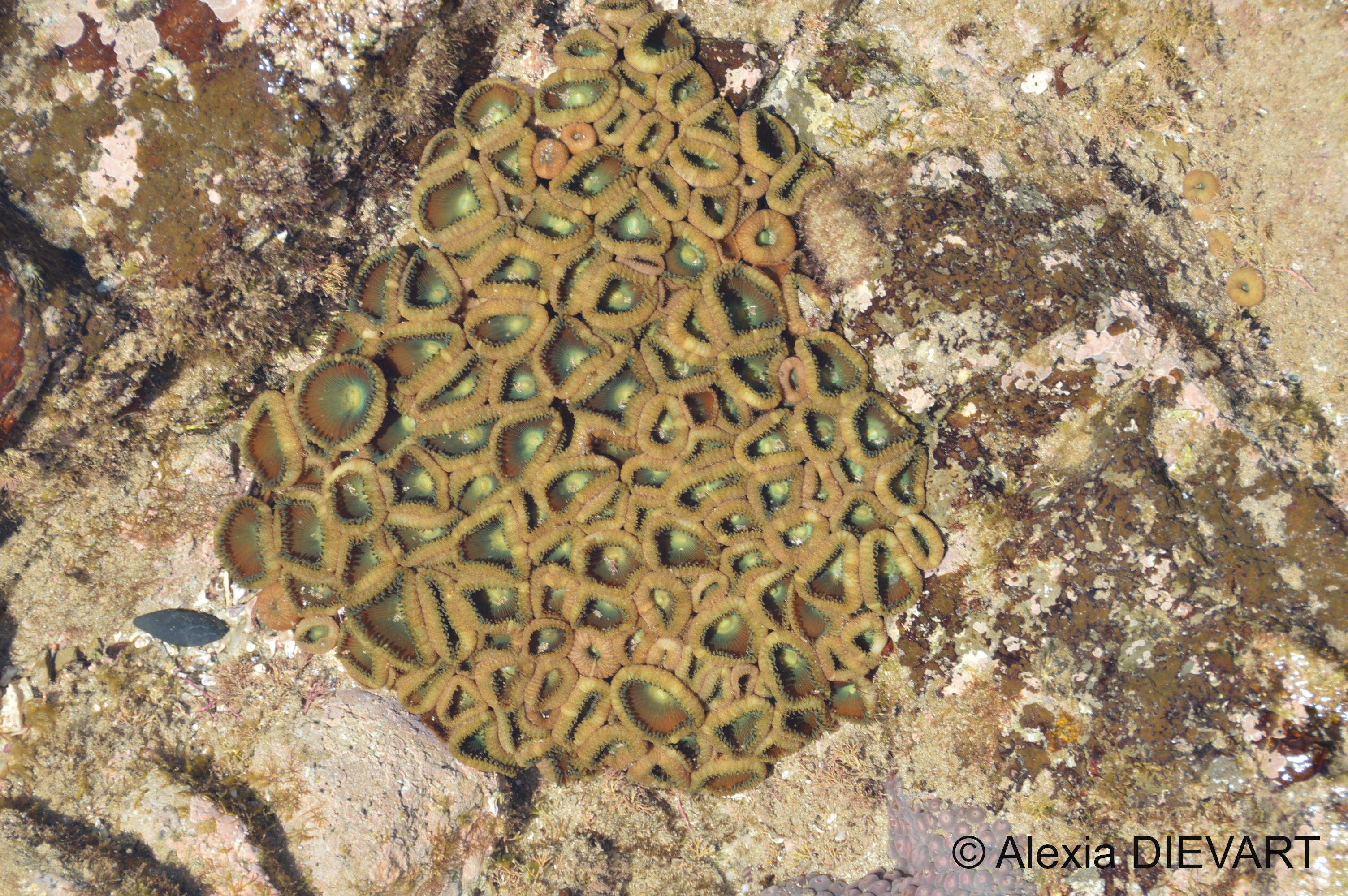
Polyps are tall and only thinly connected at their bases by underground stems – called stolons. Column brown, embedded with fine sand grains, giving a sandpapery texture. Column trumpet-shaped when expanded. The wide oral disc at the top has furrows that radiate from the mouth to the edge of the disc and ranges from bright green to brown. Relatively short tapered tentacles.
30 mm tall, 10 – 15 mm wide.
Abundant in low shore pools, especially in areas periodically covered by sand. Broad zoanthids can multiply by budding.
Two Oceans: A Guide to the Marine Life of Southern Africa (1994)
Taxonomy
This species is referred to as the columnar sandy zoanthid in many South African marine identification guides. As zoanthids are poorly represented in recent literature, the green button polyp fared by many scientific names, including Protopalythoa nelliae (uncertain) and Palythoa nelliae.

Port St Johns, Wild Coast, Eastern Cape (2021).
Recently, a possible synonymy was found with P. nelliae and P. mutuki based on genetic studies on mitochondrial 16S rDNA and ITS rDNA (Risi & MacDonald, 2015).
Indeed, images of Palythoa mutuki are very similar to the morphotypes of Palythoa nelliae observed in South Africa. Both have ‘liberae’ and ‘intermediae’ polyp structure, which widens from the base upwards and a yellow-brown polyp column color. They are both found in extensive colonies, and exhibit an oral disk which colors range from brown to green for P. nelliae and dark brown with green fluorescence for P. mutuki when underwater.
Zoanthids as a habitat
Zoanthids form encrusting mats in low shore pools along the rocky shores of tropical oceans. They are normally exposed during neap tides and are subjected to the pounding of the waves. Sand particles, broken shell pieces and sediments cover the outer walls of the polyps. And since they are often found on wave-beaten rocky shores, they accumulate lot of organic and inorganic particules, as well as micro- and macro-organisms, when the tide recedes.

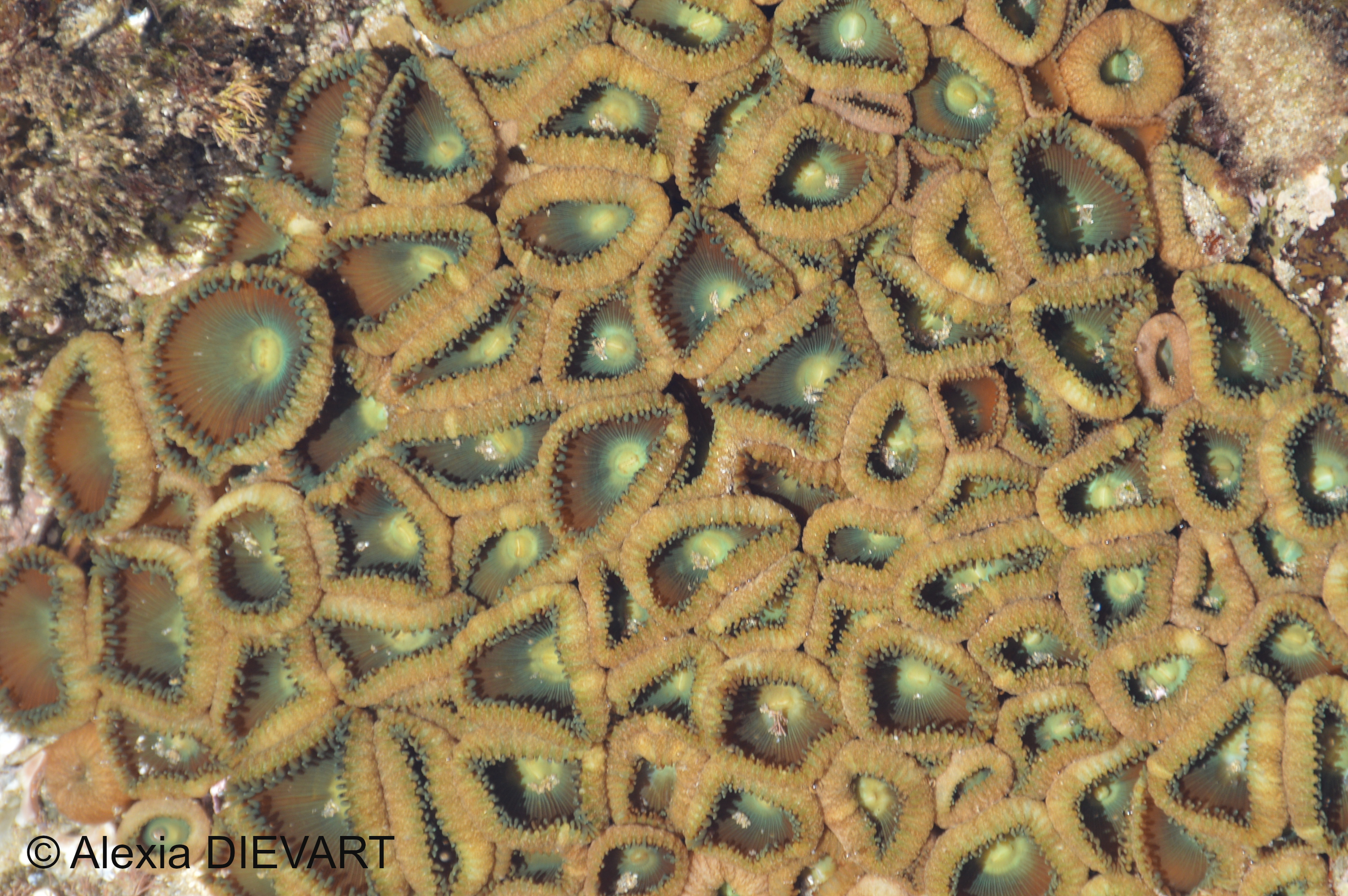
Port St Johns, Wild Coast, Eastern Cape (2021).
A number of organisms have been seen associated with zoanthids, either as epibionts or endobionts, since zoanthids are sessile. Hydroids, gorgonians, black corals and corals. These organisms appear to have different relationships with the zoanthid, ranging from commensalism, mutualism, symbiosis to parasitism.
EPIBIONT (noun) : Any organism that lives strictly attached to the surface of another living organism. EXAMPLE : A barnacle on a mussel.

ENDOBIONT (noun) : Any organism that lives strictly within the body or cells of another organism.

References
Chakravarty, M.S., Sudha, B.S., Ganesh, P., 2016. Some animal associates of the zoanthids, Palythoa mutuki (Haddon & Shackeleton, 1891) and Zoanthus sansibaricus (Carlgen, 1990) along rocky shores of Visakhapatnam, India – A check list. International Journal of Fisheries and Aquatic Studies 4, 380–384.

 F*CK FISH