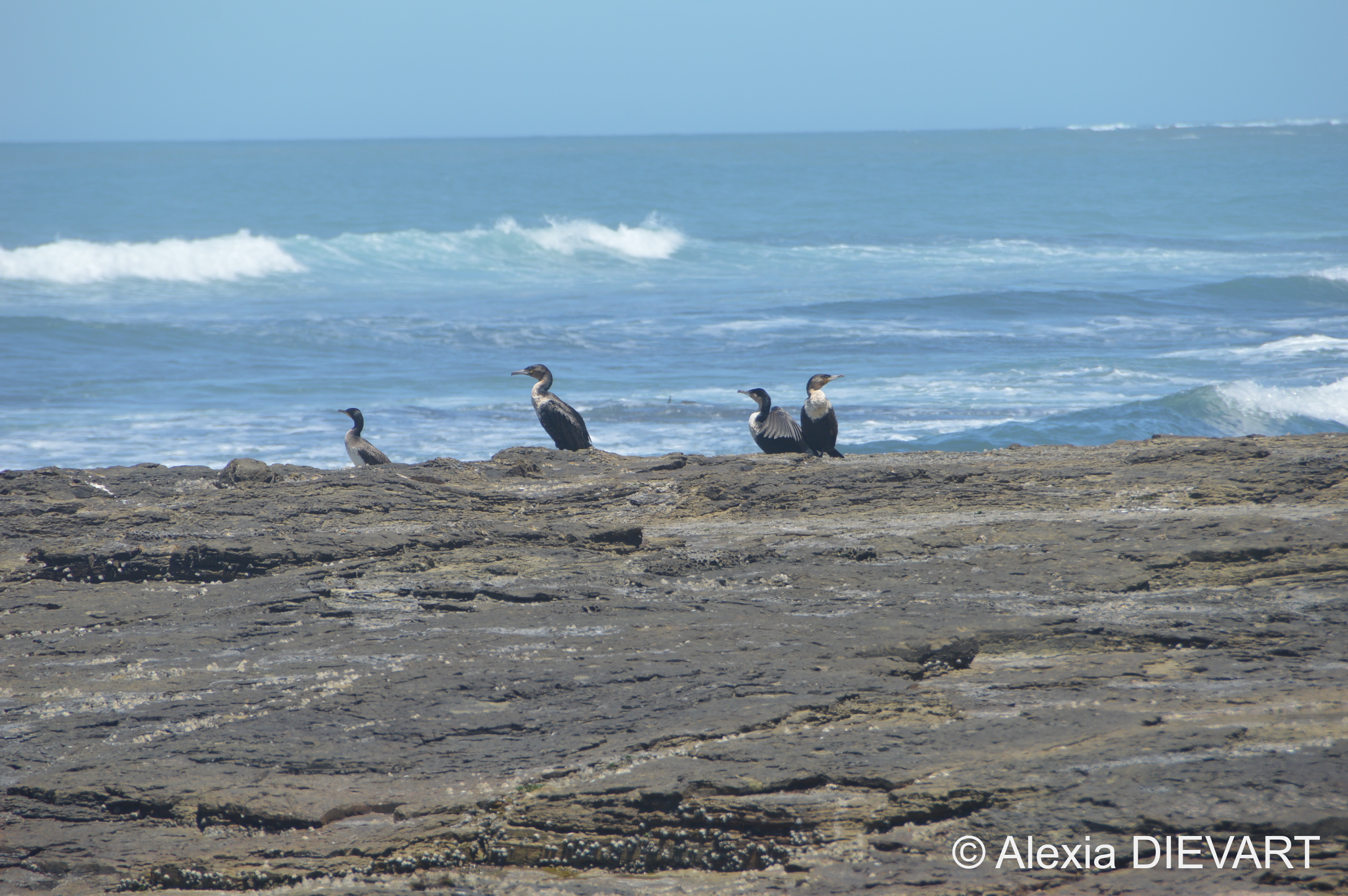
Adult has a white throat and breast, washed pink in marine populations, with white thigh patches in breeding plumage, yellow skin at the base of the bill, and turquoise eyes. Juvenile has white underparts and browner upperparts.
About 90 cm.
The largest African cormorant.
Two Oceans: A Guide to the Marine Life of Southern Africa (2017), Birds of Southern Africa (2020).
Usually nests in colonies on coastal islands or cliffs, often on man-made structures, but does also occur inland, wherever water is readily available. Locally common resident at dams, lakes, large rivers, estuaries and shallow coastal waters, favoring areas where the bottom sediments are sandy. Breeds colonially in trees, bushes or reds, on cliffs or on the ground on islands, sometimes with other waterbirds.
Feeds on fish.
The taxonomic status of the white-breasted cormorant has been under discussion for some decades and several questions still have not been definitively settled. Indeed, Phalacrocorax lucidus is sometimes treated as a subspecies of the great cormorant, Phalacrocorax carbo [Wikipedia].

 F*CK FISH