
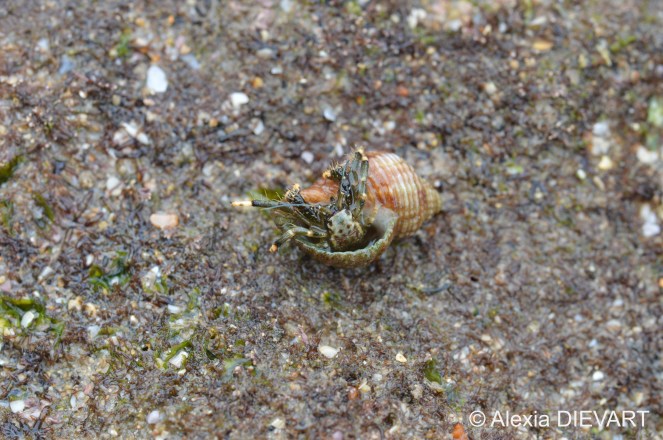
Body olive-green. Nippers about equal in size, spotted with yellow. Fingers yellow with black tips. Walking legs banded with yellow.
Between 10 and 20 mm.
Abundant hermit crab in mid-to-high shore pools in Natal.
Two Oceans: A Guide to the Marine Life of Southern Africa (2007).
Discover in Video
Coming soon …
Discover in Image
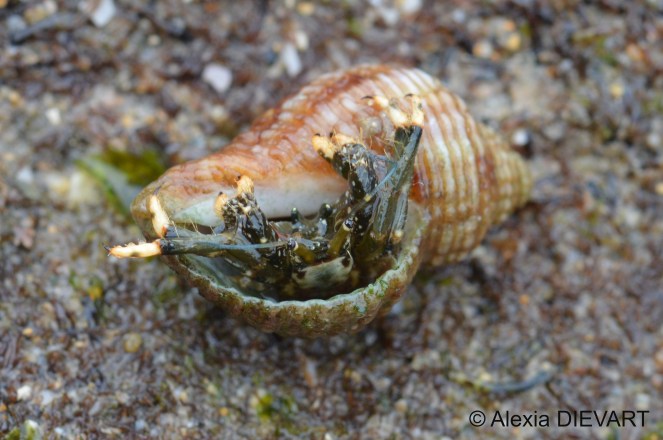
Finding a home on the rocky shores
Hermit crabs are wholly reliant upon abandoned mollusc shells to protect their soft body from predation, physical stresses and competition. As specifically suitable abandoned shells are a limiting resource in the environment, shell utilization in hermit crabs are influenced by the local availability in gastropod shells which gives rise to a fierce interspecific and intraspecific competition amongst hermit crabs of different species and individuals within the same species (Barnes, 2003).
Although it is one of the most encountered hermit crabs in South Africa and the Indo-Pacific region, little data is locally available on the shell utilization and the population dynamics of Clibanarius virescens (Reddy & Biseswarm 1993; Nakin & Somers, 2007; Wait & Schoeman, 2012). Compared to other South African hermit crabs, Clibanarius virescens is rather small, which makes it less competitive to pre-empt empty shells, but possesses equal-sized nippers, which allows it to use a wide range of shell shapes (Branch et al., 2016). It seems to be restricted to rocky shores and has not been observed walking on the beach during the day (Nakin & Somers, 2007).
In Natal, Clibanarius virescens uses 23 different gastropod shell species, of which 18 were high-spired (Reddy & Biseswarm, 1993). While 83.5 % of the total number of shells inhabited were high-spired, C. virescens utilizes 12 % of the low-spired crowned turban shells (Turbo coronatus) in the natural habitat. In the Eastern Cape, C. virescens disproportionately occupied Burnupena shells, especially B. lagenaria and B. cincta, confirming its preference for high-spired gastropod shells (Nakin & Somers, 2007; Wait & Schoeman, 2012).
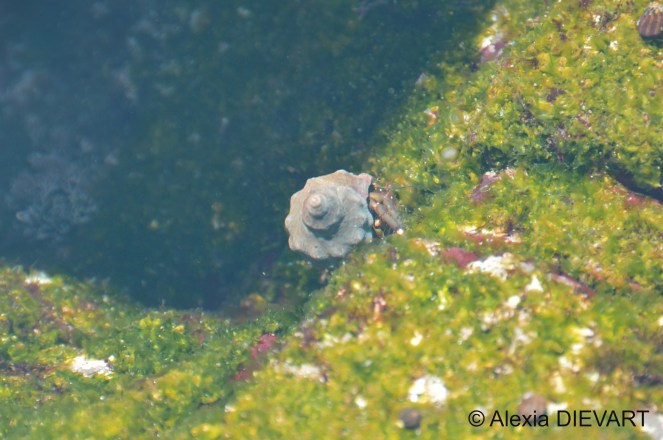
Low-spired shells – such as the one in the picture below – are unsuitable for the yellow-banded hermit crab as they do not retain sufficient water, but are probably locally selected due to their abundance and the scarcity of preferred shell types (Reddy & Biseswarm, 1993).

 F*CK FISH