
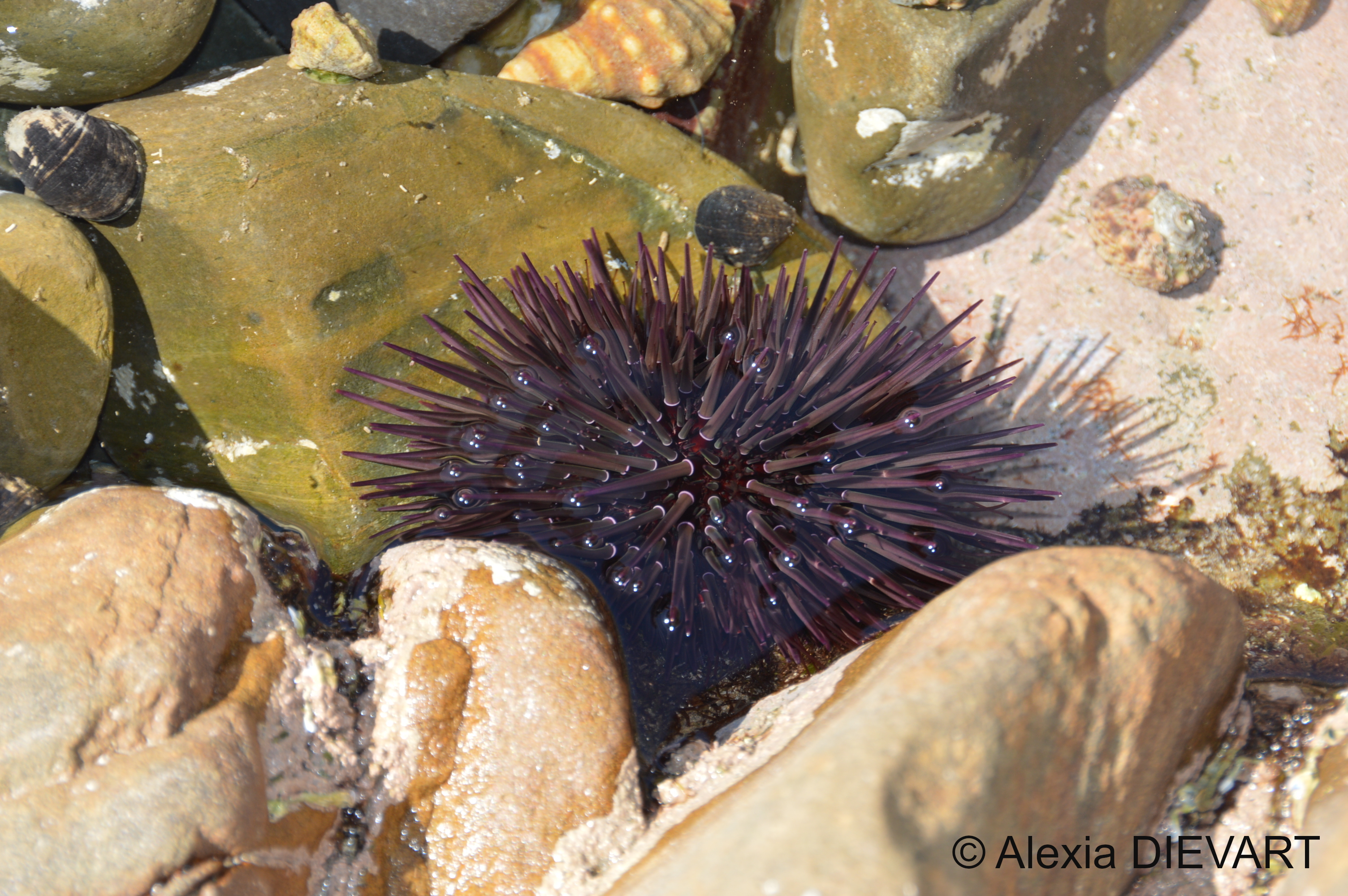
Also referred to as the burrowing urchin or the rock-boring urchin.
Test oval when viewed from above, purple to black. Spines fairly long and stout, tapering evenly to a sharp tip. Spine color purple, brown or green, sometimes with white tips, and a characteristic pale ring at the base of each spine.
About 50 to 70 mm in diameter.
The most common urchin in East Coast rock pools. Occurs on reefs in tropical parts of the Indo-Pacific Ocean, down to 139 meters deep, from Madagascar, the East African coast and the Red Sea to Hawaii. A mobile grazer which occupies hollows in exposed reefs, catching drifting algae or emerging to graze at night.
Two Oceans: A Guide to the Marine Life of Southern Africa (1994, 2016).
A Natural Bioeroder
Echinometra mathaei uses its spines and teeth – part of the mouthparts known as the Aristotle’s lantern – to dig itself into the basaltic and calcareous rock where it lives. Its burrows are extremely irregular, and are usually not made by a single urchin but rather are occupied as a pre-formed crevice (Russo, 1980).
E. mathaei has been observed to move within and around its burrow (Abbott, 1974), but seems to remain sedentary in areas of vigorous water flow (Russo, 1977), as long as its food supply is sufficient (Kelso, 1970; Russo, 1977).
E. mathaei defends its burrow from conspecifics intruders, but the majority of these interactions result in several urchins coexisting in the same longitudinal burrow, similarly to other urchin species (Langdon, 2012). Defense of and sharing of longitudinal burrows may also be associated with predator avoidance behaviors (Langdon, 2012).
Because of its burrowing activities, Echinometra mathaei contributes significantly to coral reef bioerosion – the destruction and removal of calcareous substrata by living organisms.
Feeding Behaviour
Echinometra mathaei do not leave their burrows to graze during the day, to shelter themselves from predators, but were observed to create ‘algal gardens’ within longitudinal burrows at night (Langdon, 2012).
In the intertidal, Echinometra mathaei remains in its burrow and feeds on drifting algae falling into it when the tide is high (Kelso, 1970; Russo, 1977). In the subtidal, E. mathaei emerges at night to graze on algae close to its burrow (Khamala, 1971).
Reproduction
As with other marine organisms, gametes (i.e., eggs and sperm) are released into the water column where fertilization occurs.
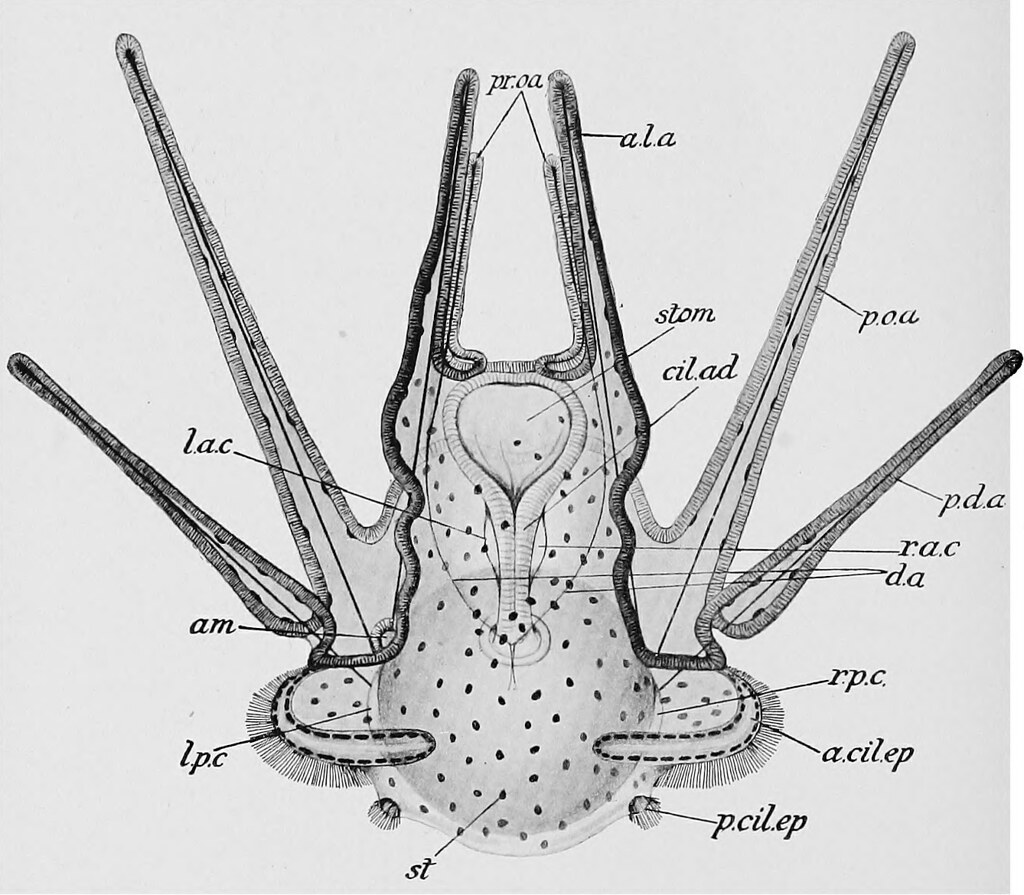
After fertilization, the echinopluteus larvae are planktonic and possess limb-like outgrowths bearing ciliated bands.
When these settle on the seabed, they undergo metamorphosis into juvenile sea urchins.
Natural predators
Predators of the rock-boring urchin are mostly finfish, and to a lesser extent, brittle stars and gastropod mollusks. In areas of heavy fishing pressure, the number of urchins often increases because their natural predators are less abundant, which increases reef bioerosion.

 F*CK FISH