

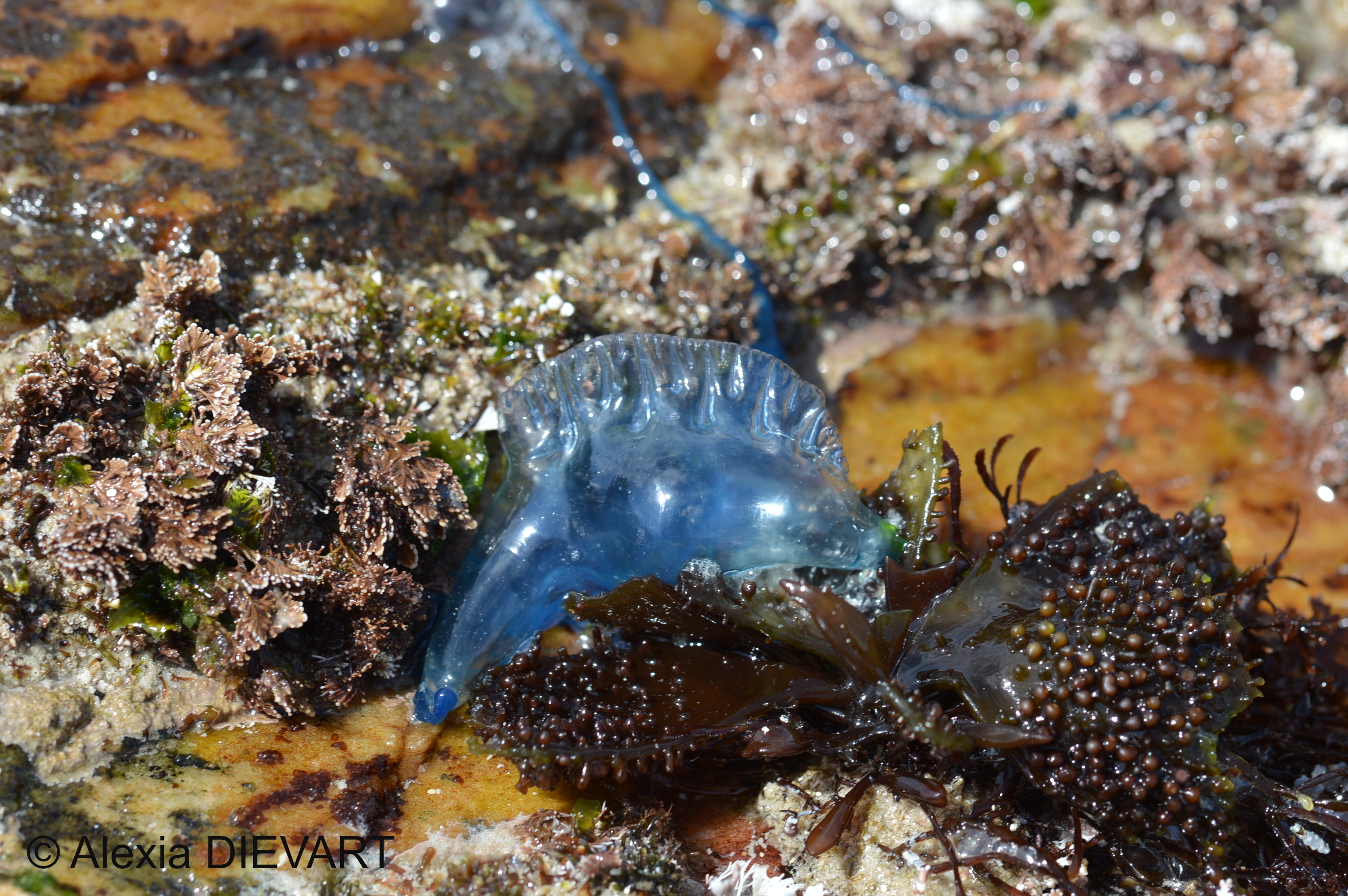
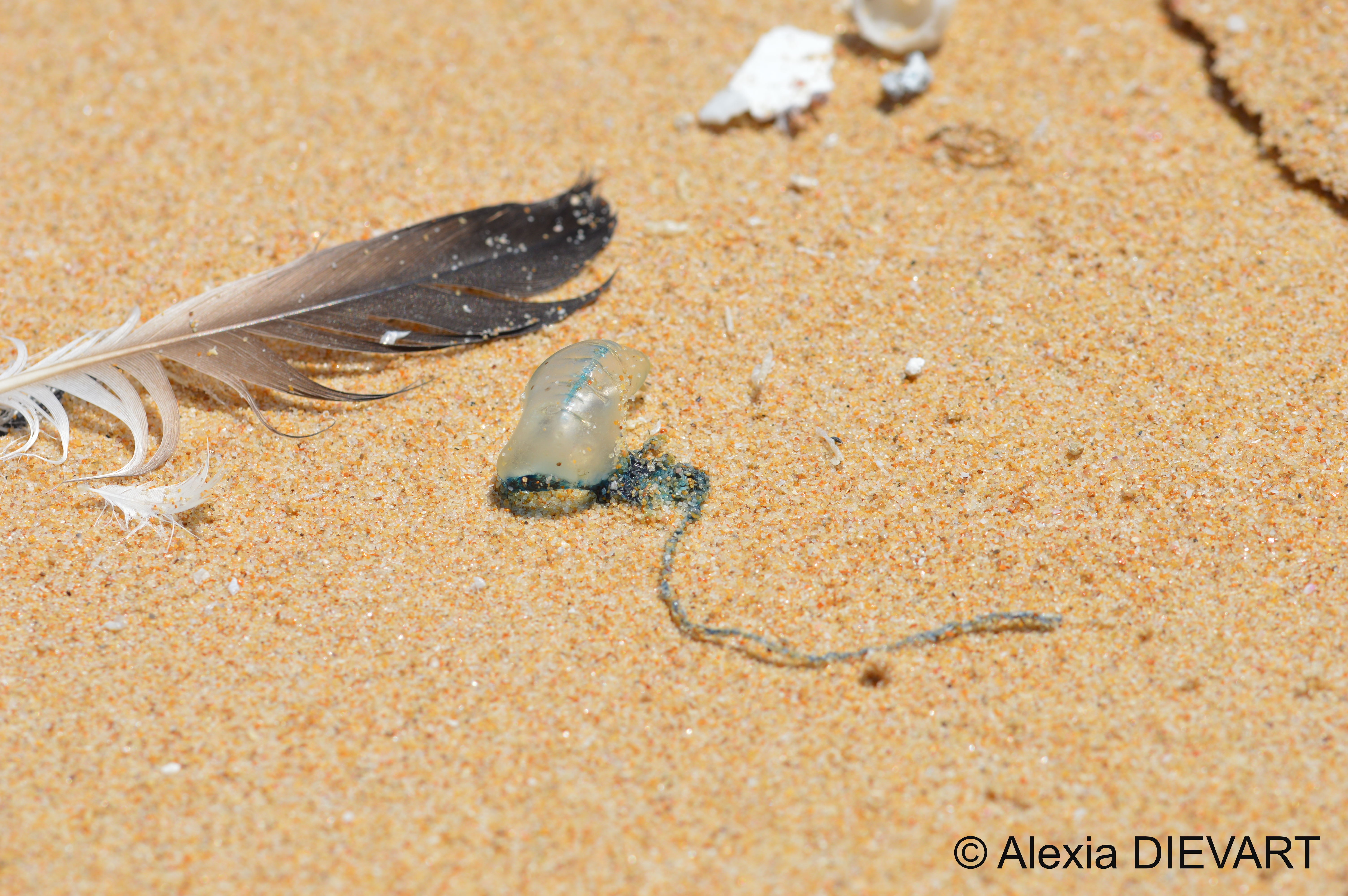
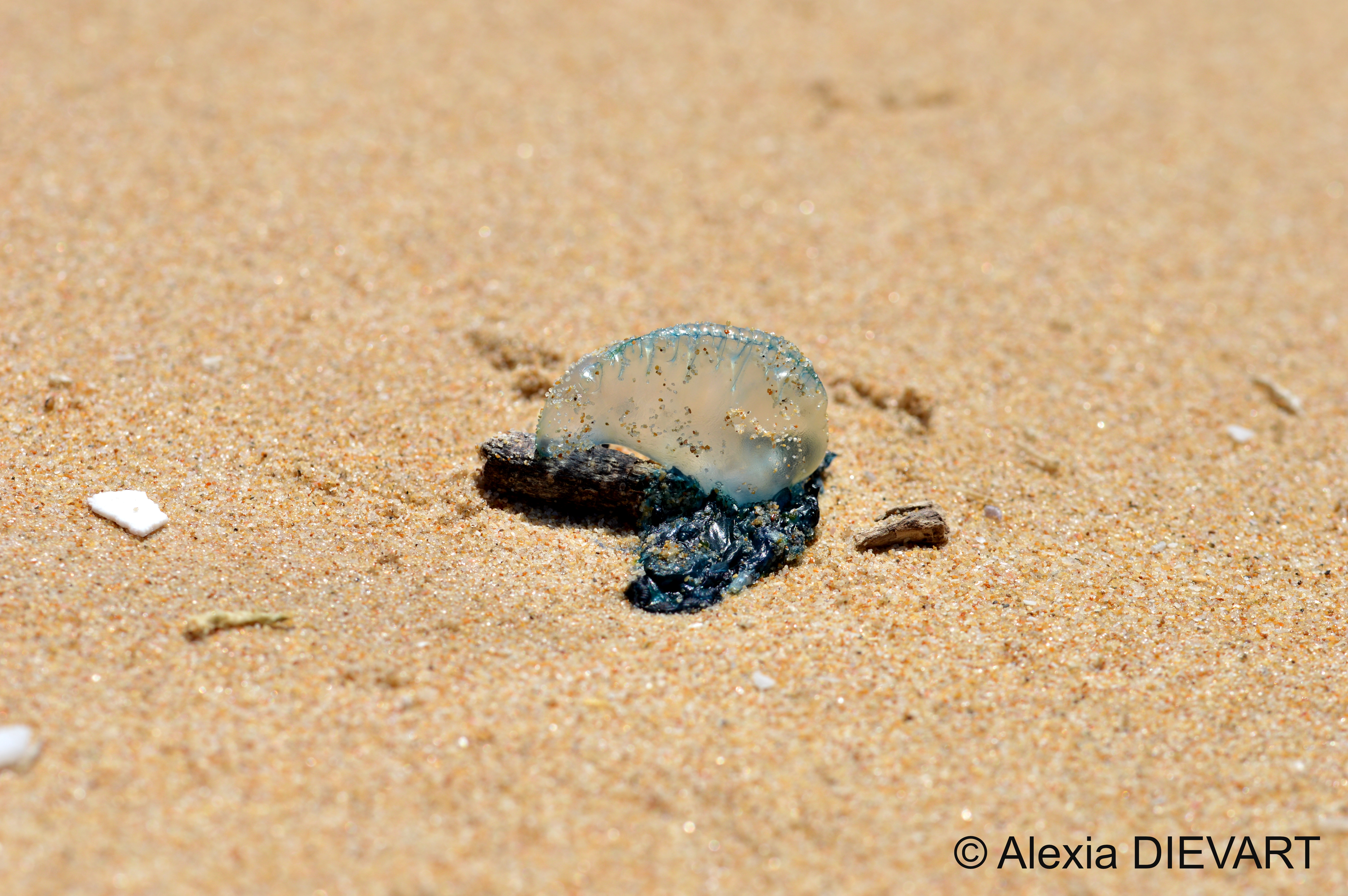
Unmistakable with its inflated blue-green float and long trailing tentacles.
Float 50 mm long, tentacles up to 10 m long, but contracting to about 30 cm.
Floats on the surface of the sea and is vulnerable to being cast ashore by onshore winds. Because of shapes of their floats, ‘left-handed’ and ‘right-handed’ individuals are blown to port or starboard respectively. On the West Coast of South Africa, there tend to be more left-handed individuals because they are less likely to be stranded by the prevailing south-easterly winds.
Two Oceans: A Guide to the Marine Life of Southern Africa (1994, 2016).
Bluebottles inflict painful stings, best treated with vinegar and ice. Severe cases are rare, but can lead to potentially lethal cardiovascular and respiratory collapse. Such cases should be treated by a medical practitioner with intravenous antihistamines and steroids.
Despite their venomous stings, bluebottles are regularly eaten by the sea swallow and by plough snails.
Discover in Image
One species or many ?
Physalia is an iconic cosmopolitan marine genus of neustons, organisms that live at the surface of the water, that regularly washes up on beaches around the globe and is known to inflict painful stings. Also called the bluebottles, specimens in the genus Physalia are uniquely suited to long-distance travel, using its gas-filled float and muscular crest to catch the wind and sail the sea surface. For these reasons, the genus has had quite a complex taxonomic history, being described under more than 50 different names over the last few centuries !
While most know the emblematic Portuguese man-o-war (Physalia physalis) floating in the Atlantic ocean, a second species was believed to occur in the Indo-Pacific and southern Africa, baptized Physalia utriculus (Branch et al., 2016). However, in 2019, a comprehensive review recognized a single species, Physalia physalis, and stated that to establish the validity of several more species, definite morphological differences would need to be established (Pugh, 2019).
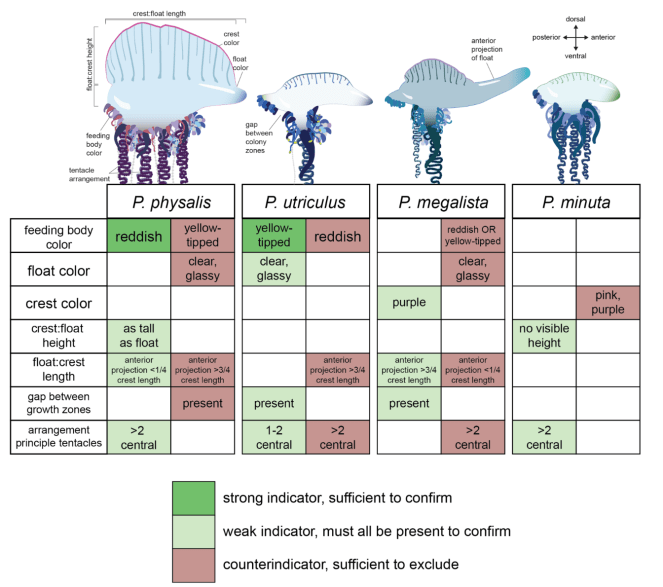
Evidence is now here ! Church et al. (2025) differentiated at least four different species of Physalia based on whole genome sequencing and morphological analyses of iNaturalist observations. Out of these four species, three correspond to species proposed by scientists in the 18th and 19th centuries – like Physalia utriculus, along with a new species, Physalia minuta Church and Dunn, sp. nov. Moreover, Church et al. (2025) observed strong reproductive isolation between species despite range overlap and significant intraspecific population structure, with persistent regional subpopulations consistent with predominant currents and winds.
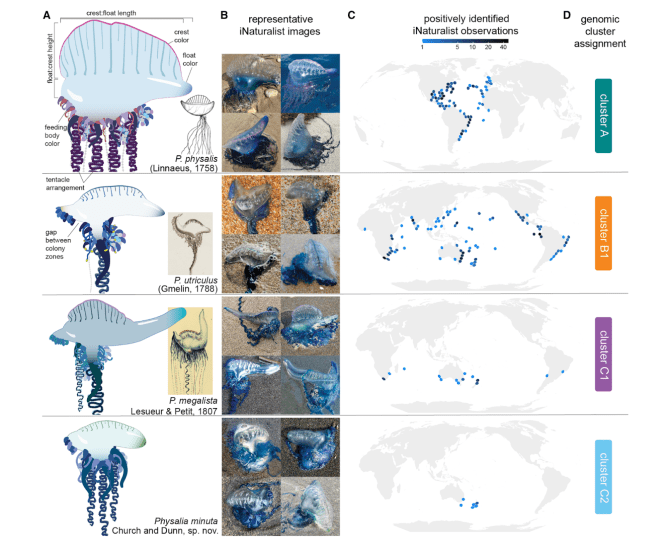
(b) representative photos, (c) distributional ranges of positively identified iNaturalist observations, and
(d) genomic cluster assigned to each morphology (Figure 3 in Church et al., 2025).
So, why this taxonomic back-and-forth ? In the 18th century, hypotheses about multiple species of bluebottles emerged based on reports from global voyages. Over the course of 250 years, these species were described, proposed, debated, and ultimately rejected. Unfortunately for taxonomists in past centuries, it was impossible to observe live or recently beached Physalia specimens across its vast distributional range, and key characteristics like posture, color, and behaviour are lost during fixation. Nowadays, photography-based citizen science and social media provide an unprecedented lens on biodiversity and helped disentangled a complex taxonomic history !
REFERENCES
Branch GM, Griffiths CL, Branch ML, Beckley LE (2016). Two Oceans: A guide to the marine life of southern Africa, 4th edition. Struik Nature, Cape Town.
Church SH, Abedon RB, Ahuja N, Anthony CJ, Destanović D, Ramirez DA, Rojas LM, Albinsson ME, Álvarez Trasobares I, Bergemann RE, Bogdanovic O, Burdick DR, Cunha TJ, Damian-Serrano A, D’Elía G, Dion KB, Doyle TK, Gonçalves JM, Gonzalez Rajal A, Haddock SHD, Helm RR, Le Gouvello D, Lewis ZR, Magalhães BIMM, Mańko MK, Mayorga-Adame CG, De Mendoza A, Moura CJ, Munro C, Nel R, Oguchi K, Perelman JN, Prieto L, Pitt KA, Roughan M, Schaeffer A, Schmidt AL, Sellanes J, Wilson NG, Yamamoto G, Lazo-Wasem EA, Simon C, Decker MB, Coughlan JM, Dunn CW (2025). Population genomics of a sailing siphonophore reveals genetic structure in the open ocean. Current Biology:S0960982225006827.
Mesaglio T (2025). Physalia physalis (bluebottle/Portuguese man o’ war) split into four species. https://www.inaturalist.org/posts/113902-physalia-physalis-bluebottle-portuguese-man-o-war-split-into-four-species
Pugh PR (2019). A history of the sub-order Cystonectae (Hydrozoa: Siphonophorae). Zootaxa 4669.

 F*CK FISH