

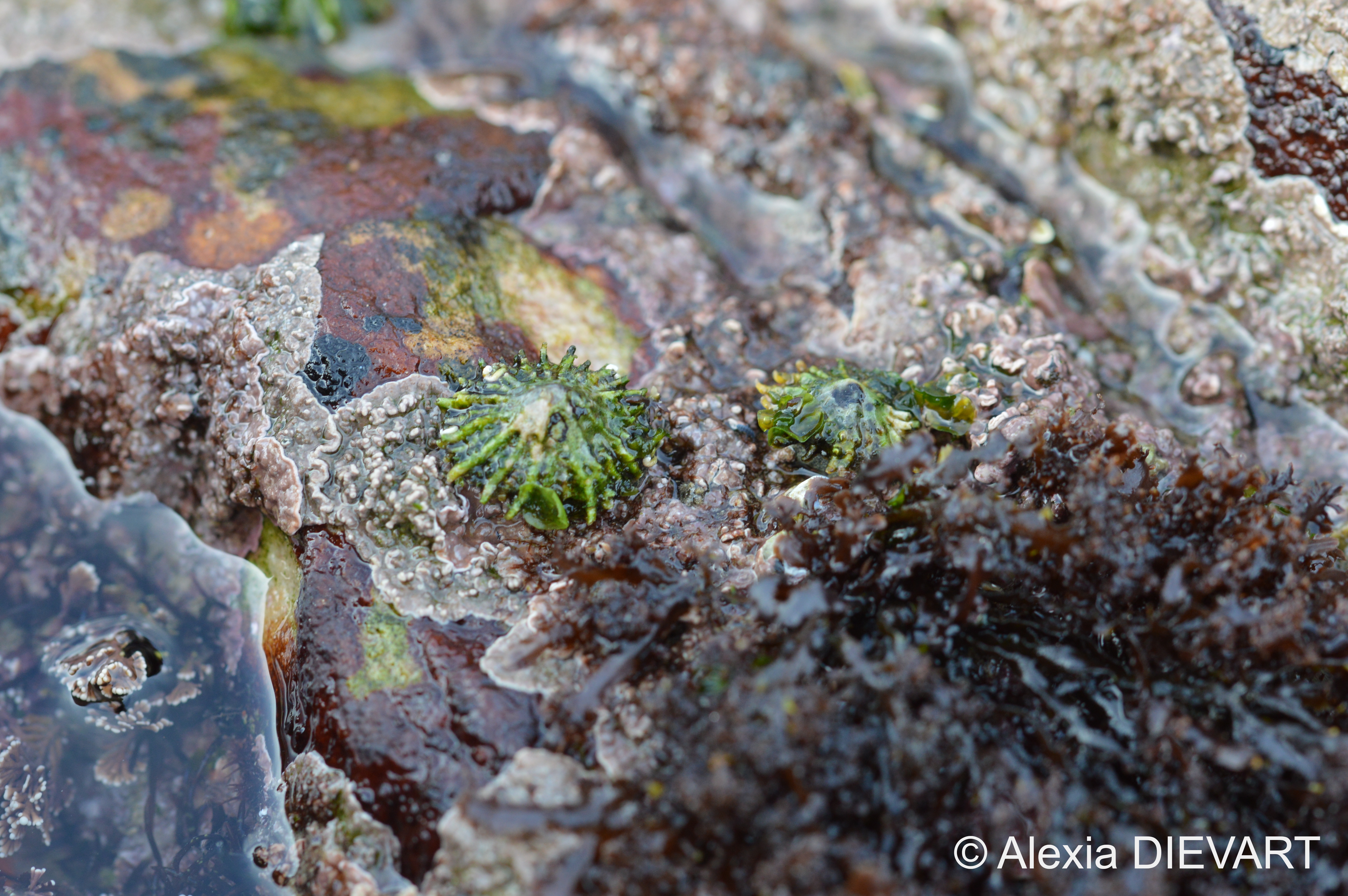
Highly variable, but typically tall, with strong, spiky ribs. Sides of the foot white, speckled grey.
About 80 mm. Maximum size : 100 mm (Kensley, 1973; Kilburn & Rippey, 1982).
Occurs on the low-shore and subtidally. On the East Coast, it defends ‘gardens’ of filamentous red algae, thrusting away other grazers that intrude. On the more productive West Coast, it lacks gardens and is not territorial.
Two Oceans: A Guide to the Marine Life of Southern Africa (1994, 2016).
Distribution & Life History Traits
Scutellastra barbara is distributed throughout the east and west coasts of South Africa, between Port Nolloth and Umpangazi (Koch, 1949; Powell, 1973). Mmonwa (2013) demonstrated that S. barbara was separated in two distinct genetic lineages, the southwestern lineage and the northeastern lineage, where the biogeographic boundary between the warm-temperate Agulhas region and the subtropical region occurs.
Adults are most commonly found low on the shore, amongst the coralline algae and the barnacles (Branch, 1971), but always in low densities (Branch, 1975). Juveniles of Scutellastra barbara commonly colonise the shells of abalones, Haliotis midae (Branch, 1975), which has been interpreted as a behaviour directed towards protection against other herbivores.
Scutellastra barbara possesses morphological and ecological characters of territoriality and non-territoriality, and can thus be considered an ‘intermediate grazer’ (Branch, 1975). Indeed, S. barbara defends territories of the filamentous algae it feeds on only along the South coast of South Africa, but not along the West coast (Ridgway et al., 1999).
Scutellastra barbara has been observed to spawn between May and June (Branch, 1974), and its larvae has a planktonic development.
REFERENCES
Branch, G.M., 1975a. Notes on the Ecology of Patella concolor and Cellana capensis , and the Effects of Human Consumption on Limpet Populations. Zoologica Africana 10, 75–85. https://doi.org/10.1080/00445096.1975.11447494
Branch, G.M., 1975b. Mechanisms Reducing Intraspecific Competition in Patella spp.: Migration, Differentiation and Territorial Behaviour. The Journal of Animal Ecology 44, 575. https://doi.org/10.2307/3612
Branch, G.M., 1974. The Ecology of Patella Linnaeus from the Cape Peninsula, South Africa. 2. Reproductive Cycles. Transactions of the Royal Society of South Africa 41, 111–160. https://doi.org/10.1080/00359197409520068
Branch, G.M., 1971. The Ecology of Patella Linnaeus from the Cape Peninsula, South Africa. I. Zonation, Movements and Feeding. Zoologica Africana 6, 1–38. https://doi.org/10.1080/00445096.1971.11447402
Espinosa, F., Rivera-Ingraham, G.A., 2017. Biological Conservation of Giant Limpets, in: Advances in Marine Biology. Elsevier, pp. 105–155. https://doi.org/10.1016/bs.amb.2016.10.002
Kensley, B.F., 1973. Sea shells of southern Africa, 1st ed., ed. M. Miller, South African Museum, Cape Town.
Kilburn, R., Rippey, E., 1982. Sea shells of Southern Africa. Ed. Macmillan South Africa ; Distributed by ISBS, Johannesburg : Beaverton, Or.

 F*CK FISH