
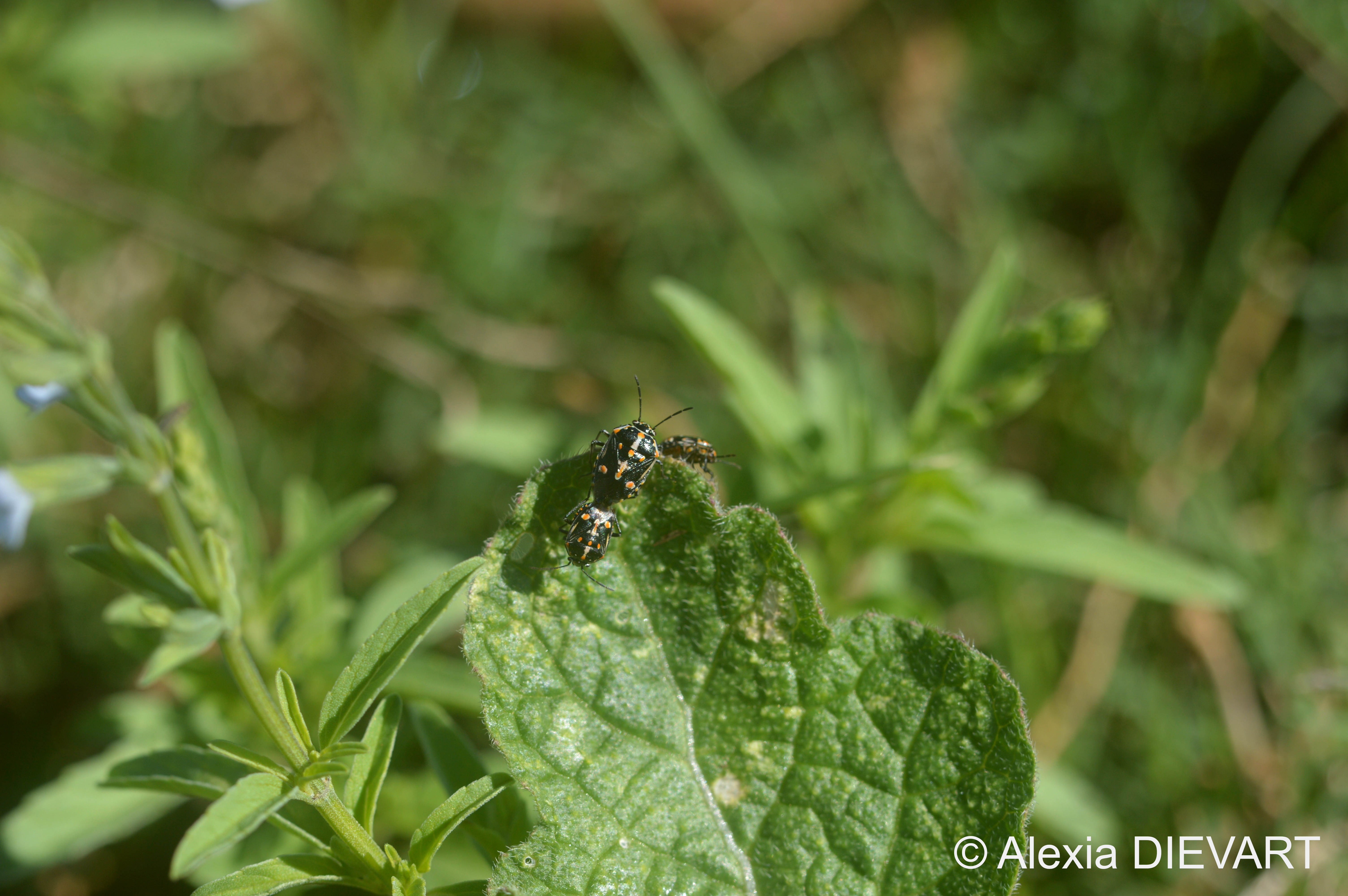
Also called the bagrada bug, or the twee-twee-luisie.
Adult males and females are similar in appearance, with the female being larger. Back of both sexes black with orange and white spots. Underside of the abdomen varies from black to dark cream.
Adults commonly found copulating and positioned end-to-end. Overwinters in the adult stage and lays eggs in the spring through early fall. Unlike other stink bugs, eggs are laid individually or in small groups, on the undersides of leaves, hairy stems of plants, and in cracks in the soil.
Bagrada Bug : A Pest ?
Native to southeastern Africa, the bagrada bug has been reported has an introduced species in many other countries, including the USA, where it is considered a major pest of plants in the Brassicacea family (e.g., cabbage, kale, cauliflower, brussel sprouts, broccoli) and related crucifers such as turnips and mustard.
In order to feed, the bagrada bug inserts its needle-like mouthparts into the plant tissues, primarily leaves, flowers and young seed pods, injects digestive enzymes and suck the juices. Bagrada bug feeding results in a starburst-shaped lesions, that eventually cause leaf and seedling deaths.

 F*CK FISH