
Previously called Siphonaria deflexa.
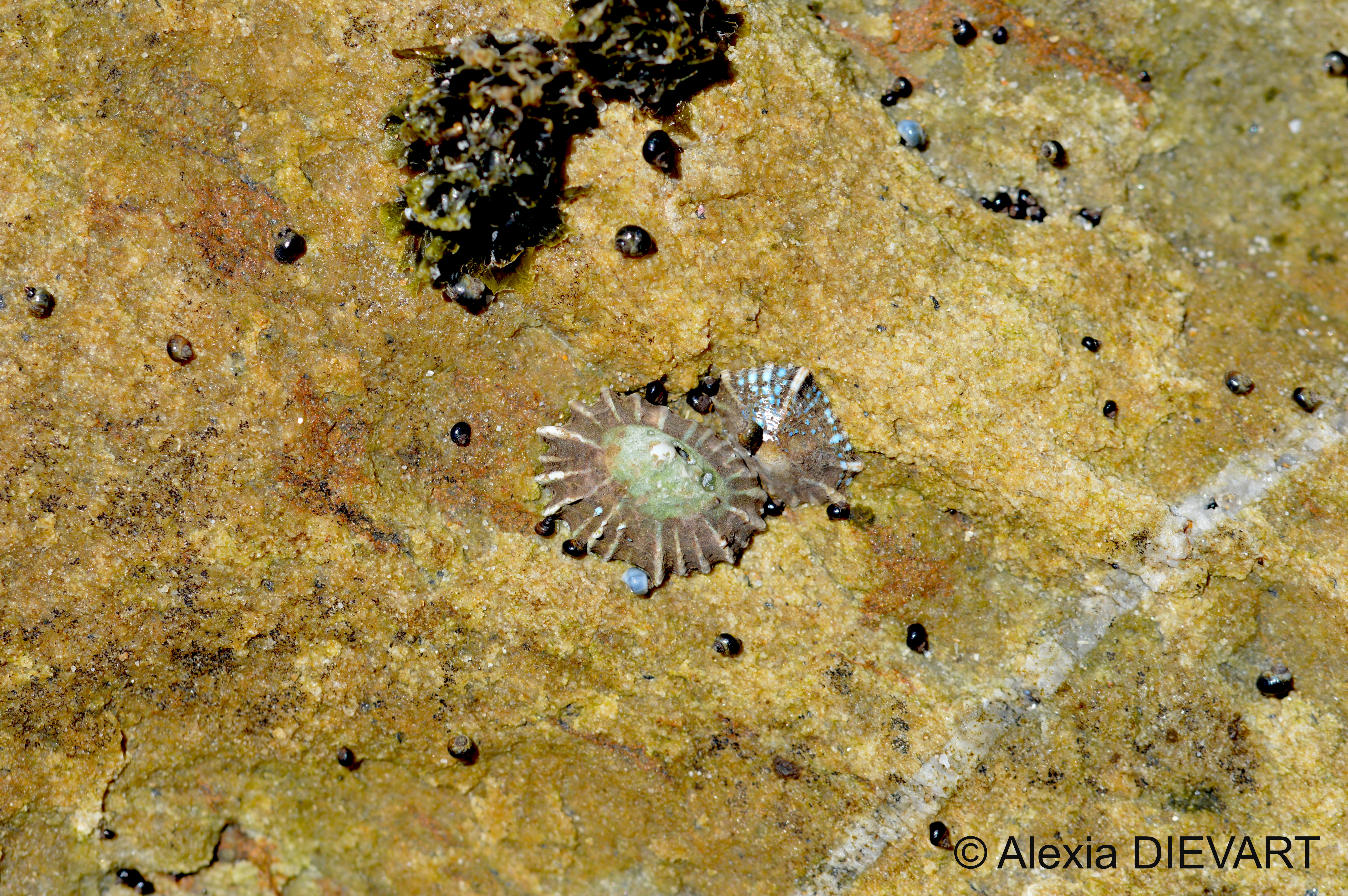
Apex of the shell almost central, smooth, white and oval. Outline oval but slightly swollen on the right to accommodate a siphon that extends outwards from the lung cavity. Ribs well-spaced and never prickly, with 20-25 (or 30 – 40) large ribs alternating with smaller ribs, irregularly projecting beyond the crenulated shell margin.
Inside of the shell black to dark brown, with a distinct white oval area dorsal to the adductor muscle and corresponding to the eroded dorsal apex.
Side of the foot with fine white spots.
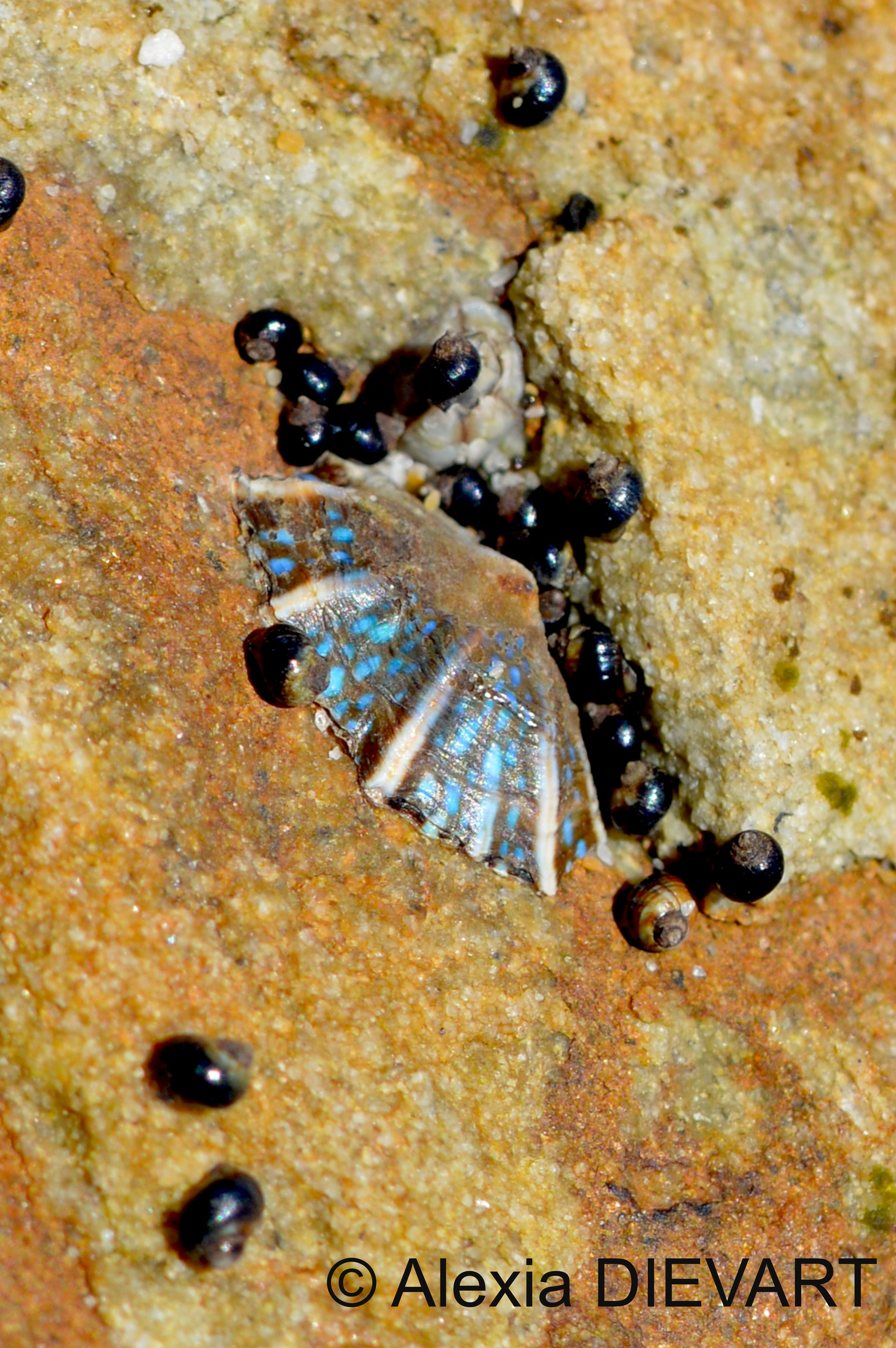
Juveniles have iridescent blue-green flecks on the outer surface of the shell.
About 15 – 25 mm in shell length.
Lives in pools and on exposed rock surfaces in the mid-shore. Like other Siphonaria species, it is tolerant of sand cover. In areas where rocks are intermittently covered with sand, it replaces the less tolerant Scutellastra granularis as the commonest mid-shore limpet.
Two Oceans: A Guide to the Marine Life of Southern Africa (1994, 2016).
Each Siphonaria limpet has a fixed home scar to which it returns after feeding. Feeds during low tide to avoid being washed away by waves. Its tissues are laden with a toxic milky mucus that repels predators.
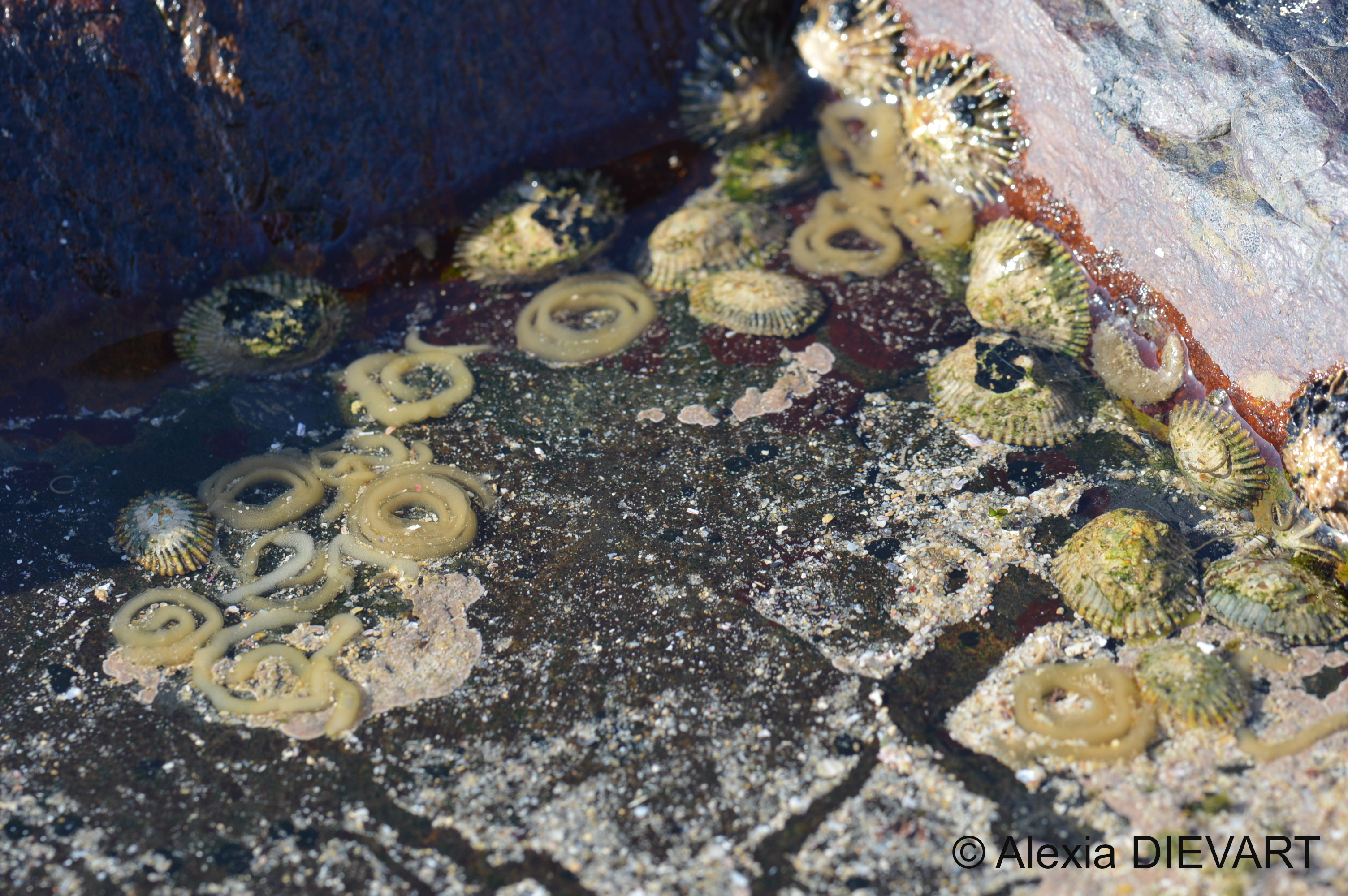
Eggs are laid in gelatinous rings that festoon rock pools.
Ubiquitous along the south and east coasts, extending to the sub-tropical waters of Durban, and becoming rarer east of Durban, although isolated populations are found as far east as Kosi Bay.
Discover in Image

Foraging Behaviour
During day-time low tides, Siphonaria concinna forms clusters of 3 – 35 individuals that aggregate in rock crevices or indentations on the surface of boulders.
The ribbed false-limpet forage mainly during the nocturnal low tide, and around dusk and dawn to avoid being swept away by waves (Gray & Hodgson, 1997), as they have a low tenacity. They remain completely inactive at high tide. They can travail greater distances on spring tides than on neap tides. It is not known if the limpets graze throughout the excursion or not, but they do follow a non-random direction that take them upshore and towards smooth flat rocks.
Foraging excursions can be divided into 3 distinct phases : a relatively rapid outward phase, a much slower foraging phase (1 – 3 hours), and a rapid homeward phase.
Siphonaria concinna goes back to a fixed home-scar at the end of its foraging excursions, and scar-swapping can occur (Gray & Hodgson, 1997). When returning to its home-scar, the limpet rotates its shell until the shell margin fits the rock surface exactly, the shell seldom touching the rock until the correct orientation is achieved. Occupying a fixed scar during the day reduce desiccation and appears to be a feature of the Siphonariid limpets.
Reproduction
All Siphonariid limpets are hermaphroditic, internal fertilisers and produce gelatinous egg masses – called ‘spawn’ – usually attached to the substratum.
Siphonaria concinna has a typical planktonic juvenile and produces egg masses in a coil-shape – in contrast with Siphonaria capensis that produces a ribbon-type egg mass (Chambers & McQuaid, 1994). Egg masses are tall and narrow in cross-section, with a large surface area, so the egg coils trap water during emersion and reduce desiccation.
Juvenile ribbed false-limpets often have iridescent blue-green flecks on the outer surface of the shell (Two Oceans, 1994, 2016).

REFERENCES

Chambers, R.J., McQuaid, C.D., 1994. Notes on the taxonomy, spawn and larval development of South African species of the intertidal limpet Siphonaria (Gastropoda: Pulmonata). Journal of Molluscan Studies 60, 263–275. https://doi.org/10.1093/mollus/60.3.263
Gray, D.R., Hodgson, A.N., 1997. Temporal variation in foraging behaviour of Patella granularis (Patellogastropoda) and Siphonaria concinna (Basommatophora) on a South African rocky shore. J Mollus Stud 63, 121–130. https://doi.org/10.1093/mollus/63.2.121

 F*CK FISH
One thought on “Ribbed false-limpet (Siphonaria concinna)”