
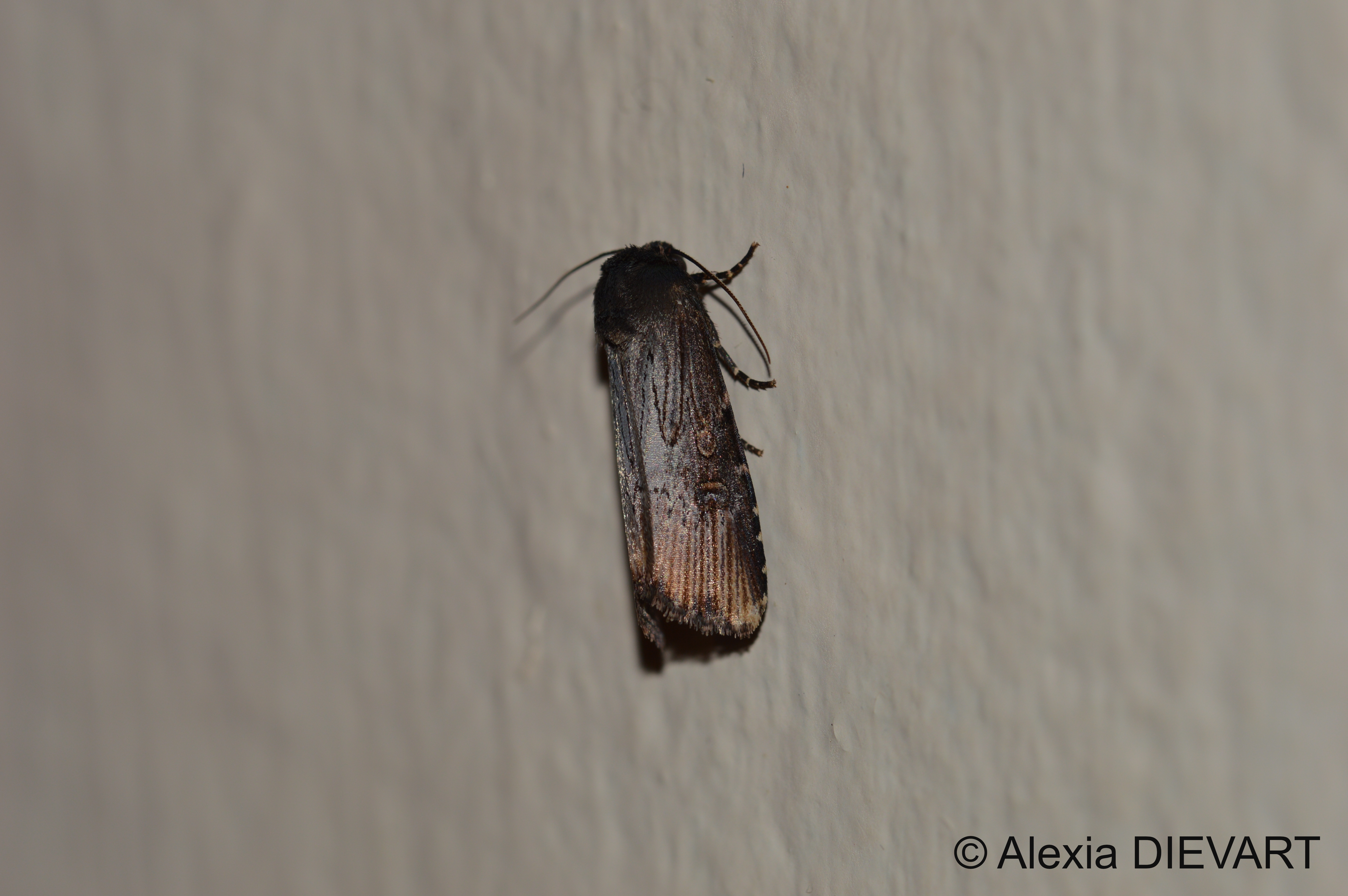
Thorax blackish-brown. Abdomen brownish-ochreous. Forewing blackish-brown in the coastal-marginal area and in the cell, bluish-grey below it, browner in the marginal area, where there are black streaks at the veins and brown ones between them. Interior line fin, double, very strongly dentated inwards. Ring-macula and reniform macula small, edged black, with ring-macula white inside and reniform macula with a dark center. From the latter, a dark undulate line to the inner margin. Exterior line close behind it, dentate, black. Fringe black and white. Hindwing white, brownish at the coastal margin.
Caterpillar host associations are unknown, but it is suspected they feed on undefined grasses.
Has been recorded from the Democratic Republic of Congo, Zimbabwe and South Africa.
When Google cannot help me …

My husband recently gifted me the beautiful naturalist book Southern African Moths & Their Caterpillars (by Hermann Staude, Mike Picker and Charles Griffiths) and I have been using it religiously to identify the countless species of moths that come invade our farm house at night. This book contains 1,500 of the 11,000 species occurring in Southern Africa, with photographs of both moths (male and female) and their caterpillars. However, as much as I searched frantically to find a specimen that resembled this beautiful dark moth – temporarily dubbed ‘The Fancy Dark Lord’, it seemed I could not find it in the guide.
Having strained my eyes attempting to find my moth in the moth guide, I decided to go with the closest species identification I could muster and tried it on the Facebook group African Butterflies & Moths – LepSoc. I was instantly humbled – in the best meaning of the term – by an online moth expert explaining that I misidentified my moth and offering me on a silver platter the correct identification. My moth was NOT in the guide. Only a single species within the genus Micragrotis was in the guide.
Now that I knew which moth species it was, I added my observation on iNaturalist as usual and discovered that there were only seven observations of this moth in all of Africa. Apparently common, Micragrotis interstriata did not receive a lot of attention it seems. And to my surprise, I could not find any description online – just a little paragraph like in the naturalist guides to add to this website.
Until my deep dive into Google results for ‘Micragrotis interstriata‘ lead me to an obscure, ancient book – I mean ancient because the first edition was published in early 1900s. In the magnificent Macrolepidoptera of the World by Adalbert SEITZ, I found a description reproduced above, and potentially the best pixel art of a moth ever seen !

Modified by Alexia DIEVART (2025).

 F*CK FISH