
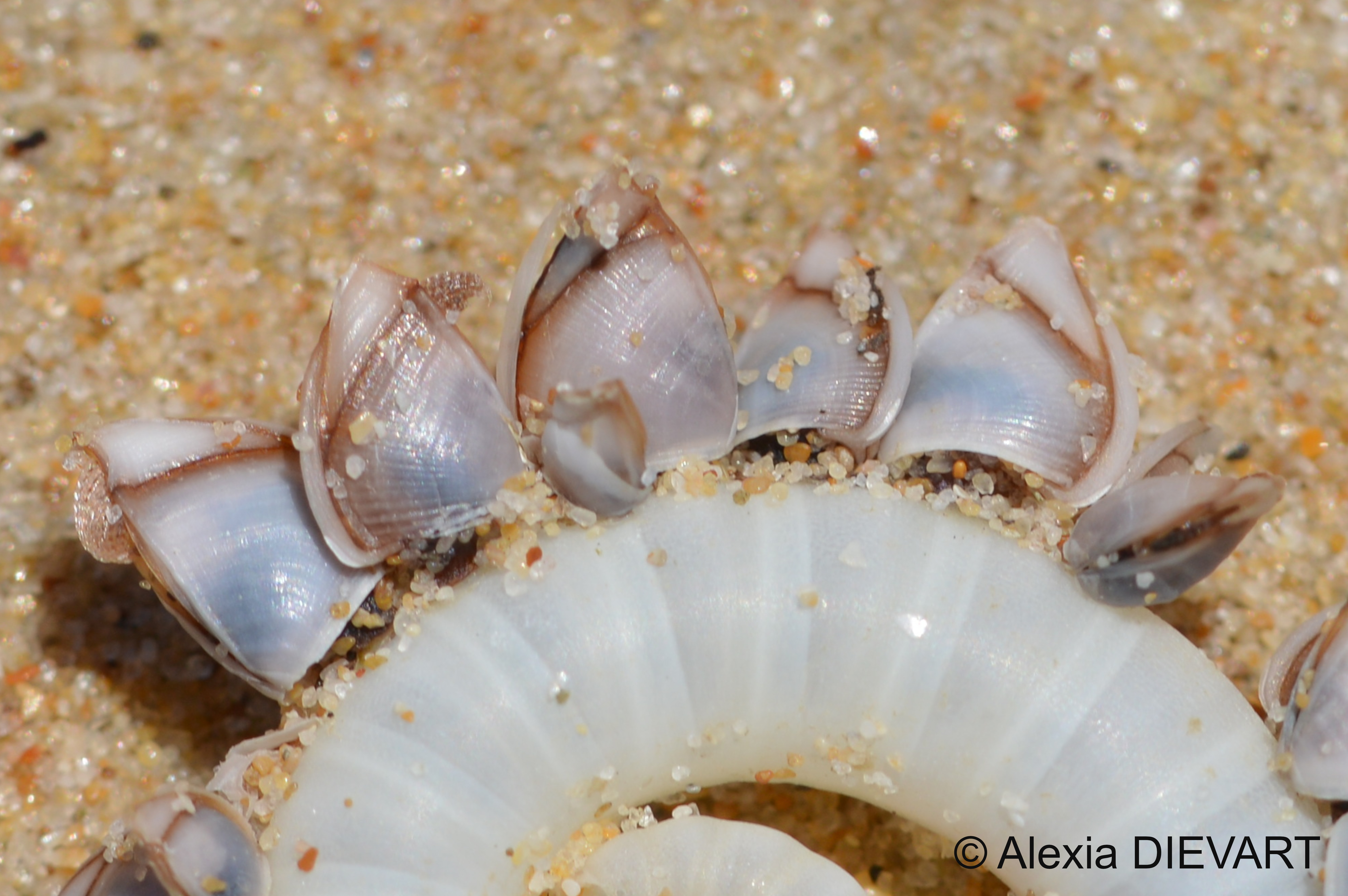
White small stalked barnacle with a light-brown always short peduncle. Body shelled with thick striated plates. Scutum round and broad, with a ridge so forward that it appears not to have one. Tergum triangular and pointy. Never has yellow margins between the shell plates or at the edge of the aperture. Can sometimes be barbed all over.
About 2 cm in capitulum length.
Occurs in small colonies on feathers, Sargassum, and small plastic objects, although it has a preference for ram’s horn shell (Spirula spirula) as a substrate.
Chan et al. (2009), Whitehead et al. 2011.
Cosmopolitan pelagic species, found chiefly in temperate and tropical seas.
Discover in Image
Although small in numbers, colonies of small goose barnacles (Lepas pectinata) prefer to attach themselves to small objects, and have a specific fondness for ram’s horn shells (Spirula spirula) (Whitehead et al. 2011). They are also found on feathers, on Sargassum in the western Atlantic ocean, and on tar pellets and small plastic pieces in Ireland.
Lepas pectinata is the smallest goose barnacle within the genus Lepas and appears to limit its individual adult size in order to reduce the colony’s impact on the substrate buoyancy (Whitehead et al. 2011).
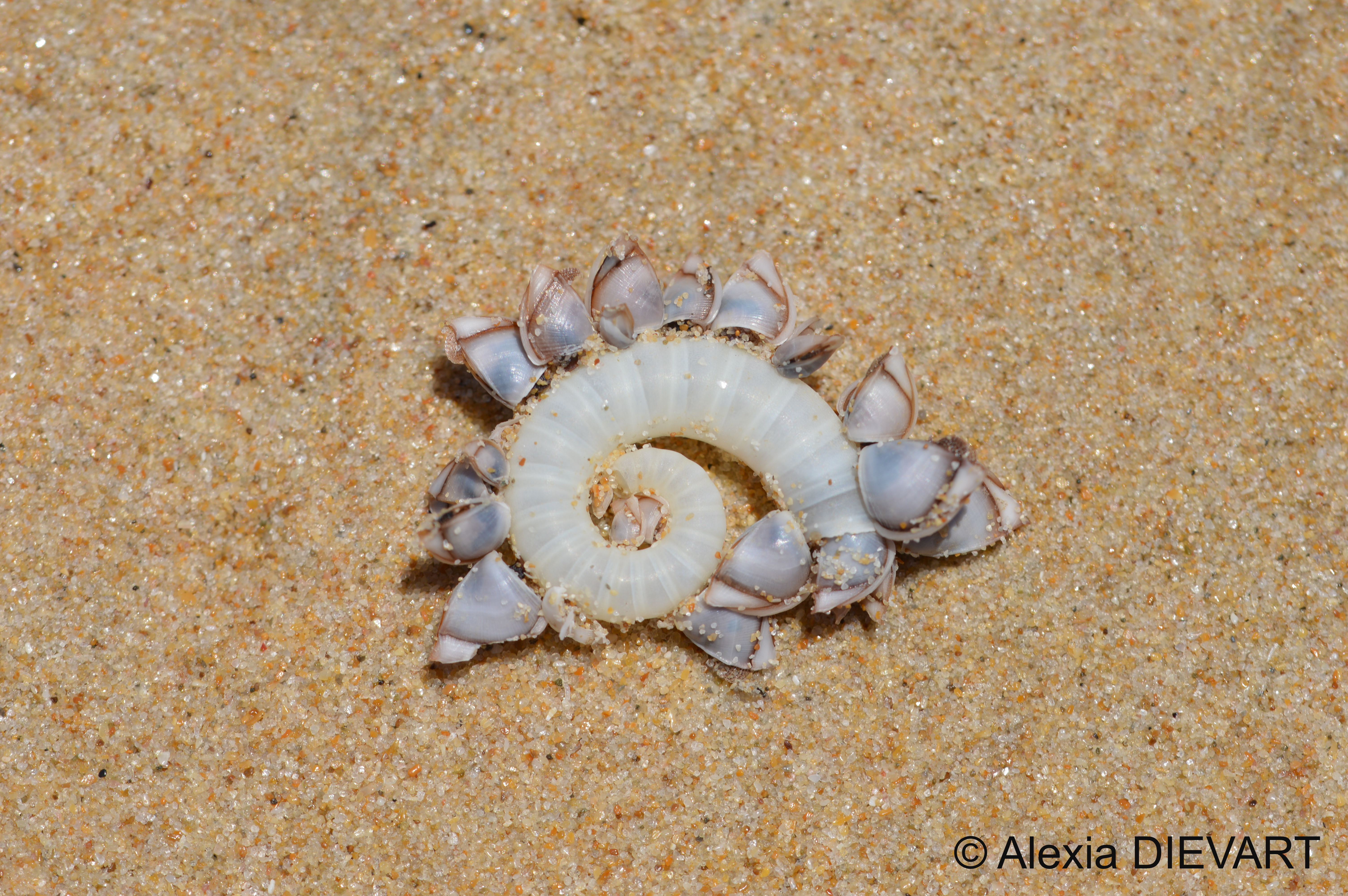
Port Alfred, Eastern Cape (2024).
Why calling it a ‘goose barnacle’ ?
Before the 11th century, bird migration was not understood. In Britain and Northwestern Europe, it was common to observe different species of geese, such as the brant goose and the barnacle goose, during the winter. However, these species of geese breed in the far North in the summer, so the nests, eggs and baby geese were unknown to the British people and associates.
It was thus believed that geese hatched from the goose barnacles found in floating ‘nests’ (e.g., driftwood) on the beach ! Because of this, the barnacle geese were considered to be fish by Roman Catholic clerics, and could be eaten on fast days, such as Lent !

 F*CK FISH
One thought on “Small goose barnacle (Lepas pectinata)”