
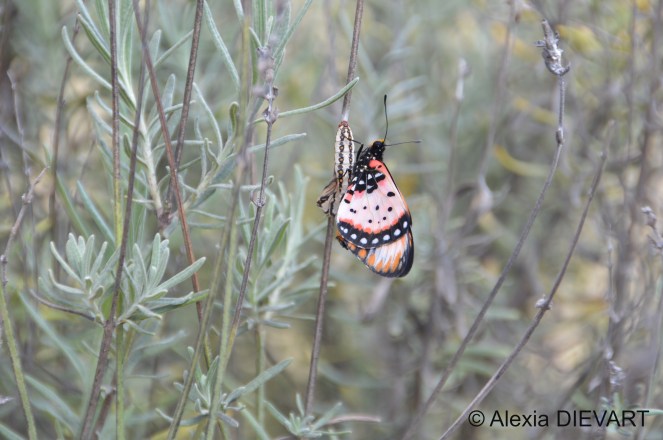
Formerly known as Acraea acara subsp. acara but revised by Williams & Henning (2023).
Upperside rufous, the base of both wings dark brown. Anterior wing with a spot in the cell, a transverse band of three spots at the middle, a broad band beyond the middle, the apex and the outer margin (marked with two rufous spots) from the middle to the anal angle, all dark brown. Posterior wing with two bands of spots and the outer margin which is broad, black.
Underside as above, except that the anterior wing near the apex and the posterior wing are carmine-white, and that there are minute spots of white at the base and a band of seven white spots near the outer margin.
Var. one-third smaller, with the outer margin above much broader, the sub-marginal spots of the underside very minute.
Acraea acara subsp. acara, on Le Site des Acraea de Dominique Bernaud.
Male or female ?
Male and females in the Acraea genus – now revised as part of the tribe Acraeini (Williams & Henning, 2023) – display a sexual dimorphism. Females are bigger, duller in colour, and their wings are more round. But that is not always true !
On the picture above, the specimen of Warrior Acraea is a male – we can barely see its orange abdomen peeking out in between its wings. Females have a black abdomen with white spots and a different abdomen terminal shape (Dominique Bernaud, pers. com., 2018, translated from French).

 F*CK FISH