

A member of the predatory chafers, in the tribe Cremastocheilini.
General body obovate, slightly convex, darkly blood-red or chestnut, shiny.
Antennae cadaneous.
Head black with yellow triangular pattern on the clypeus and frons.
Pro-thorax sub-smooth, base lightly punctate on both sides, with a total of three yellow bands – two marginally marked before the middle with a small darkly blood-red spot and one narrower in the middle and much shortened at the tip. Scutellum yellow.
Elytra sparingly sub-seriately punctulate, laterally transversely striated. Metasternite and cova ornated with large yellow spots on each side of the body. Pectoral large stripes and abdomen marked on both sides with a lateral series of five larger yellow spots.
Pygidium carinated in the middle, with a large yellow spot elevated at the apex tricuspid.18 mm long for 10 mm wide.
This is a homemade description based on translations from Latin
(see references below).Boheman (1857) and Westwood (1874), under the name Macroma cognata.
Discover in Image

The Walsingham Farm, Port Alfred, Eastern Cape, South Africa (2024).
Life history traits
The tribe Cremastocheilini corresponds to a group of beetles, commonly referred to as chafers, that exhibits unusual lifestyles and feeding modes. They are widely reported to live in association with ants and termites and, as adults, they are mainly active at night (Scholtz & Holm, 1985).
The purple predatory chafer (Campsiura cognata) is a diurnal chafer which has been recorded feeding on scale insects (Holm & Perissinotto, 2010).
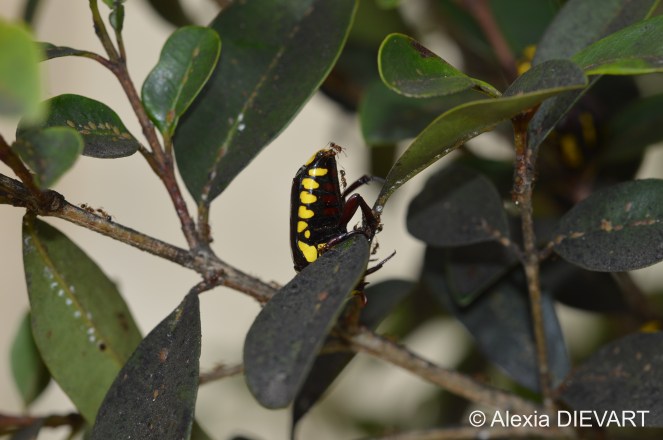
The Walsingham Farm, Port Alfred, Eastern Cape, South Africa (2024).
So little has been written on it …
For every species I photograph and feature here, I write a naturalist description – generally adapted from a local naturalist guide and completed with information gathered online. For the purple predatory chafer, Campsiura (= Macroma) cognata described by Schaum (1841), I could only find descriptions written in the 19th century, that I had to translate from Latin to English, and that is made of very specific words pertaining to the beetle anatomy.
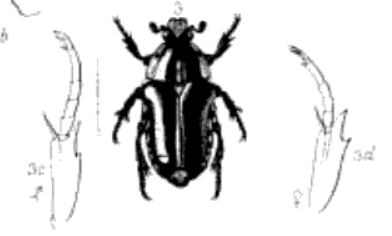
And the absolute banger of a diagram below (Plate VI, Fig. 3, Westwood ,1874) …
I think it needs a make over !
References

Boheman, C. H., Fåhraeus, Olof Immanuel., & Wahlberg, J. A. (1848). Insecta Caffrariae annis 1838-1845 a J.A. Wahlberg collecta. Ex Officina Norstedtiana. https://doi.org/10.5962/bhl.title.9375
Holm, E., & Perissinotto, R. (2010). Revision of the Afrotropical Species of the Genus Spilophorus Westwood (in Schaum), 1848 (Coleoptera: Scarabaeidae: Cetoniinae: Cremastocheilini). African Entomology, 18(1), 47-65. https://hdl.handle.net/10520/EJC32846
Westwood, J. O. (1874). Thesaurus entomologicus Oxoniensis : or, Illustrations of new, rare, and interesting insects, for the most part contained in the collections presented to the University of Oxford by the Rev. F.W. Hope ... with forty plates from drawings by the author. Clarendon Press. https://doi.org/10.5962/bhl.title.14077

 F*CK FISH