
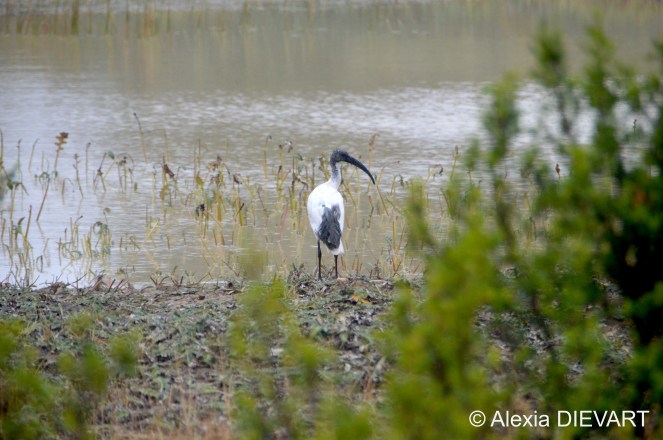
Adult with all-white body plumage, apart from dark plumes on the rump.
Bald head and neck, thick curved bill and legs black. Wings white, showing a black rear border in flight. Eyes brown with a dark red orbital ring.
Sexes similar, although males are generally slightly larger than females.
Juveniles with dirty-white plumage, a smaller bill and some feathering on the neck, greenish-brown scapulars and more black on the primary coverts.70 cm tall. 112 – 124 cm wingspan. 1.35 – 1.5 kg.
Common resident in South Africa, where first breeding colonies were recorded in the 1970s. Native from sub-Saharan Africa and eastern Iraq. Especially known for its role in Ancient Egyptian religion, where it was linked to the god of wisdom and knowledge Thoth. Usually silent bird, making occasional puppy-like yelping noises.
Birds of Southern Africa (2020).
Native or not ?
The African sacred ibis is native from sub-Saharan Africa and southeastern Iraq, where it was historically breeding. But this large bird can migrate over great distances following the rains, with some South African birds having been recorded to migrate 1,500 km, as far north as Zambia.
Before the beginning of the 20th century, this species did not breed in southern Africa. Benefitting from irrigation, dams and agricultural practices, such as dung heaps, carrion and refuse tips, it began to breed in the early 20th century in Zimbabwe and South Africa, where the first colonies of sacred ibis were recorded in the 1970s. From 1972 to 1995, the breeding population found in the Free State, South Africa, multiplied by 2-3 in response to the intensification of agricultural practices and the creation of new dams (Kopij, 1999).
The African sacred ibis is a colonial breeding species, and from the earliest times, has been very well adapted to man-modified habitats (Craig et al., 2020). Their nests are built mainly of sticks, twigs and greenery, relatively low in the tree or directly on the ground if the colony is situated on an island.
Pollution can get in your head !
When you are the top of the food chain, some pollutants can indeed get into your head ! Scavenger birds, such as the African sacred ibis residing in Pretoria, are able to bioaccumulate pollutants from the food they ingest in their favorite local garbage dumps. Doing so, they become suitable biological markers for environmental contamination in sites close to human populations.
Environmental contaminants are chemicals that accidentally or deliberately enter the environment, often, but not always, as a result of human activities. Amongst these useful-but-harmful chemicals, flame retardants are added to manufactured materials, such as plastics and textiles, to prevent or slow further development of flames after ignition. Of all the different types of flame retardants available, brominated flame retardants and in particular polybrominated diphenyl ethers – or PBDEs if we are getting intimate – were preferred because efficient and cheap. But recently, PDBEs were identified to be toxic, bioaccumulative and persistent, and are now listed as persistent organic pollutants (POPs).
Emereole et al. (2023) investigated PBDE concentrations in the grey-headed gull (Chroicocephalus cirrocephalus) and the African sacred ibis (Threskiornis aethiopicus) scavenging on a landfill site in Pretoria, South Africa. In the feathers of both bird species, seven of eight PBDEs investigated were frequently detected.
REFERENCES

Craig AJ, Hulley PE, Mullins RLG (2021). Urban birds in the Eastern Cape: local observations from Makhanda (Grahamstown) and future questions. Ostrich 92:70–82.
Emereole C, Jansen R, Okonkwo OJ (2023). Polybrominated diphenyl ethers in the grey-headed gull (Larus cirrocephalus) and African sacred ibis (Threskiornis aethiopicus). Environ Sci: Adv 2:1651–1661.
Kopij G (1999). Breeding ecology of the Sacred Ibis Threskiornis aethiopicus in the Free State, South Africa. South African Journal of Wildlife Research 29:25–30.

 F*CK FISH