Also called Scottish thistle or bull thistle.
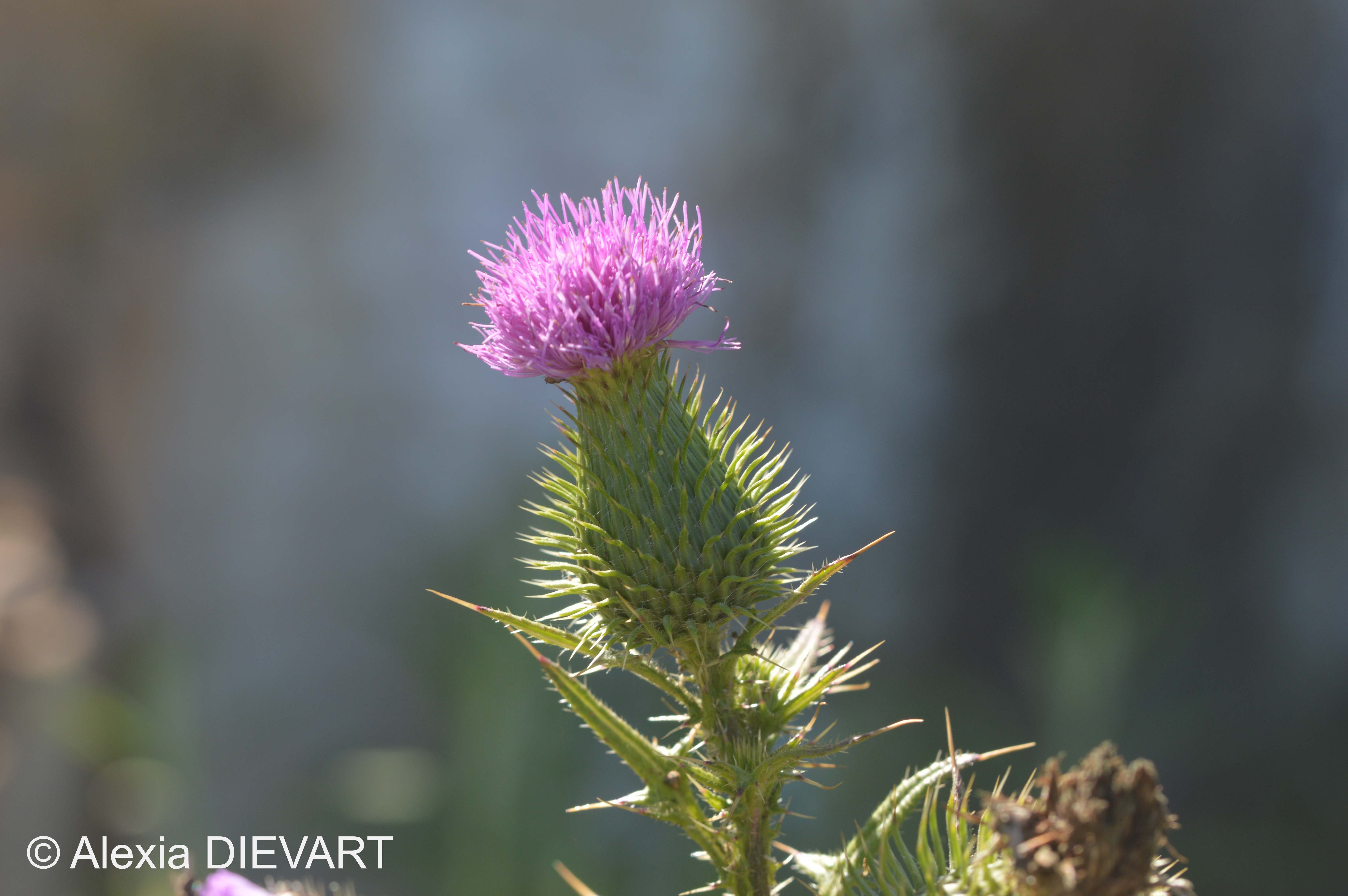
A spiny, herbaceous, biennial plant, with a large basal rosette of leaves, a deep taproot, and a flowering stem growing from the center of the rosette up to 1.5 m high. Stems have spiny wings and branches in the upper parts. Leaves dark green, with stiff hairs above, and white wooly below, deeply lobed, with the lobes ending in strong spines.
Young flower heads tear drop-shaped, with 10 to 12 series of green, spiny bracts, curling outwards. Flowers all tubular, purplish pink. Achenes are 4 mm long and 1.5mm wide, with many rows of silky-plumed pappus bristles about 20 mm long. Bristles often interlocked, and papus and seeds often distributed in a cluster.
Flowers during summer, from September to April.
Introduced, naturalized and invasive species in South Africa. Mostly regarded as a weed or undesirable plant, unpalatable to most grazing animals. Can be found throughout the country. Seeds are dispersed by the wind, animals, in mud, in water and sometimes by ants, as well as human activities, such as bailing and harvesting.
As a ruderal species, this plant is one of the firsts to colonize disturbed areas, such as grassland or forested areas, overgrazed lands, pan and dam edges and river banks, vacant fields, burnt areas, roadsides, construction sites or any disturbed sites. Fare well in most and dry conditions.
However, plants are very attractive and offer many rewards for butterflies and other insects. Its flowers are a rich source of nectar and pollen.PlantZAfrica.com (SANBI, 2017).

 F*CK FISH