
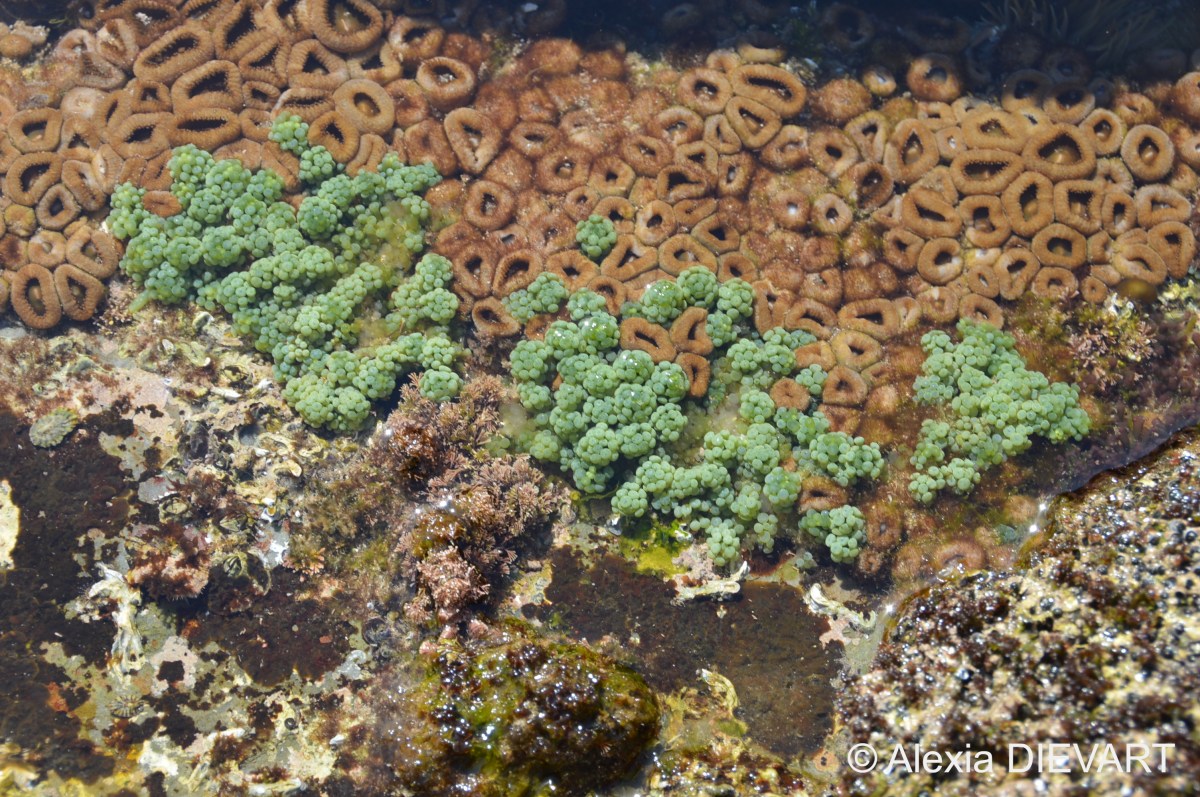
In the division Chlorophyta, green algae are the easiest to distinguish thanks to their bright green colour, and correspond to a highly paraphyletic group of mostly aquatic photosynthetic eukaryotic organisms and include about 4,300 species. Green algae are more abundant in freshwater environments, but can be found in marine habitats.
Green algae contain green pigments, chlorophyll a and b, which are the same as those found in higher land plants. Chlorophyll a traps energy from the sun and transforms it into chemical energy for the manufacture of organic compounds during photosynthesis.
Green algae have three basic body forms :
- Flat sheets, one or two cells thick, that form the order Ulotricales (e.g., Enteromorpha and Ulva).
- Filaments of cells placed end to end, that constitute the order Cladophorales (e.g., Chaetomorpha and Cladophora).
- Tubes grouped together to form more complex plant bodies, that made up the order Siphonales.
The life cycles of Chlorophyta are simple, alternating between a sporophyte and a gametophyte generation. The sporophytes produce spores which disperse, settle and develop into male and female sexual gametophytes. Gametes are released from the gametophytes and fuse to form new sporophytes. The two generations are similar in appearance.
 F*CK FISH