
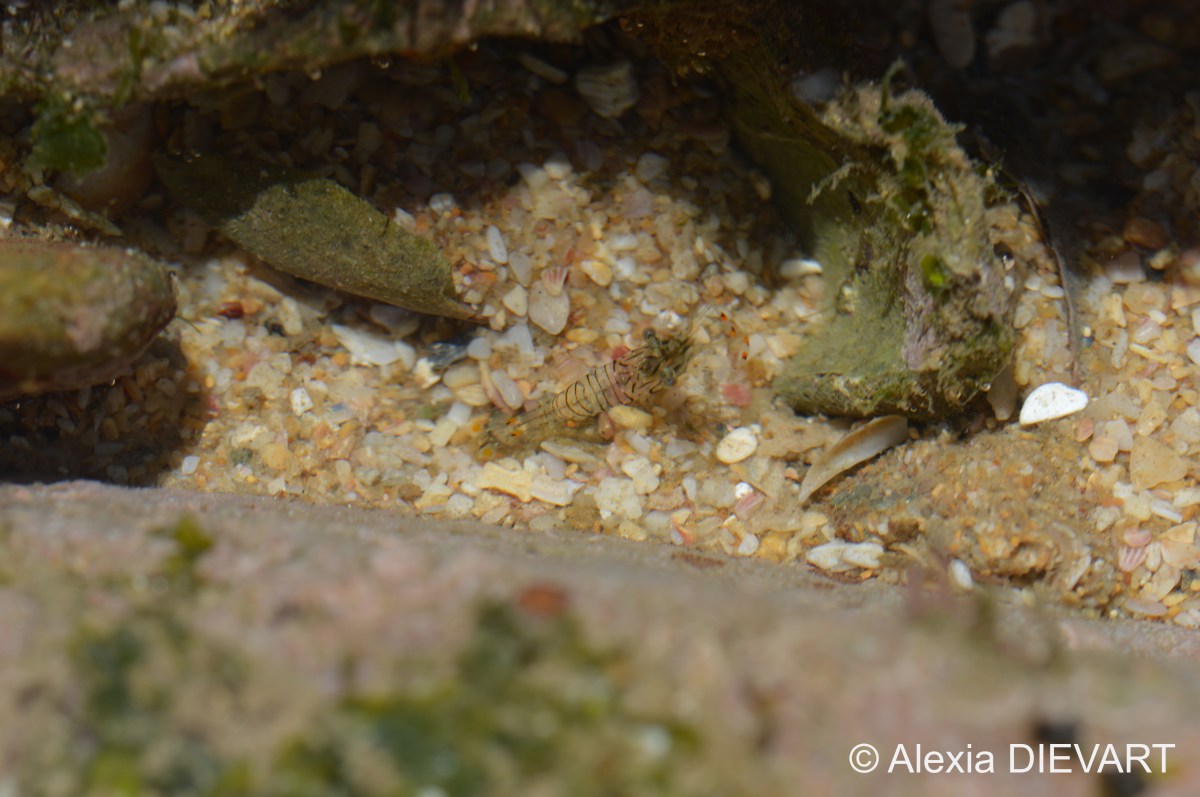
Shrimps refer to crustacean with an elongated body and a primarily swimming mode of locomotion – typically belonging to the Caridea or Dendrobranchiata, within the order Decapoda, although some crustaceans outside of this order can also be called ‘shrimp’. Under a broader definition, shrimps may also be synonymous with prawns, encompassing stalk-eyed swimming crustaceans with long, narrow muscular abdomens, long antennae and slender legs. Any small crustaceans resembling a shrimp tends to be called one.
Generally, shrimps swim forward by paddling with little swimmers on the underside of their abdomens, while their escape response is typically repeated flicks of the tail to drive themselves backwards very quickly. Crabs and lobsters have strong walking legs, whereas shrimps have thin, fragile legs which they use primarily for perching : they are more adapted for swimming than for walking.
Swimming prawns, in the family Penaeidea, are distinguished from other prawns because the sides of the first abdominal segment overlap the sides of the second segment, the last abdominal segment has a dorsal keel, and the first three pairs of walking legs end in nippers. The various species of swimming prawns are recognized by the shape of the long rostrum that projects forward between the eyes, and the number of teeth on the rostrum, as indicated by a ‘rostral formula’. Swimming prawns breed at sea, shedding their eggs into the water, but their juveniles develop in nursery areas in estuaries.
Cleaner shrimps belong to the group Stenopodidea, and are similar to swimming prawns, except for the possession of large nippers on the third pair of walking legs.
On the other side, bottom-dwelling (or benthic) prawns, in the infraorder Caridea, are ill-suited for swimming and are distinguished by the fact that the sides of the second abdominal segment overlap those of the first and thirds segments, the dorsal surface of the last abdominal segment is rounded, not keeled, and the third walking legs lack nippers. Some species occur in estuaries, but none depends on estuaries as nursery grounds, and none is of commercial importance.
 F*CK FISH