
Sponges are members of the phylum Porifera and are primitive sedentary animals which lack a mouth, a brain, digestive track or any other conventional organ. These sessile filter feeders are bound to the seabed, and are one of the most ancient members constitutive of the macrobenthos, with many historical species being important reef-building organisms.
Sponges are multicellular organisms consisting of a few types of cells forming tissues that are supported by a skeleton made of fibrous material, called collagen or spongin (as in the familiar bath sponge), or of lime or silica spicules, or of a combination of these. The type of skeleton and form of the spicules are important features in the classification of sponges.
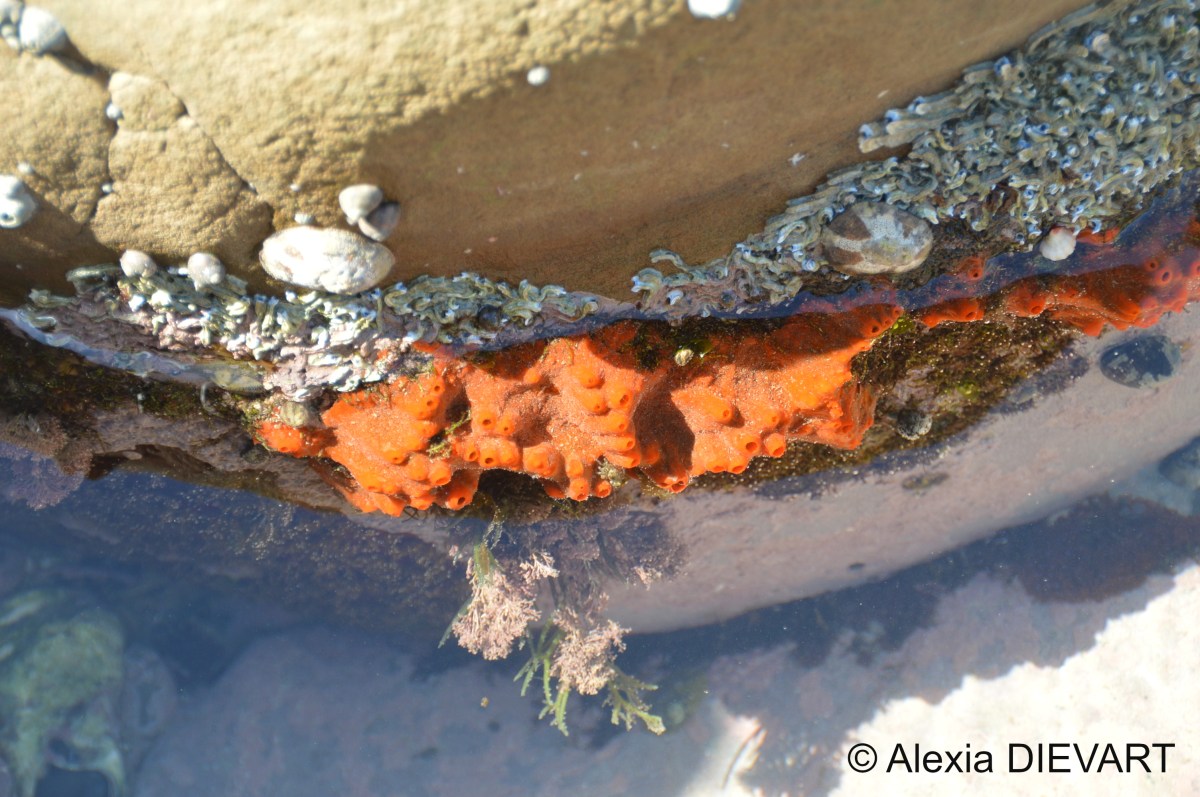
Water and small food particles enter the sponge through numerous tiny pores which dot the body surface, and exit via one of a few larger openings – called ‘oscula’ – which are often raised like turrets. Collar cells line the body cavity and beat their hair-like flagellae to generate the water flow and filter out food particles through their net-like collars.
Sponges reproduce either by budding or by producing planktonic larvae.
Although sponges are conspicuous on rocky reefs, particularly in temperate areas, the southern African species are extremely poorly known and many remain unnamed.
 F*CK FISH