
Less known than their counterparts, the starfish, brittlestars constitute the class Ophiuroidea.
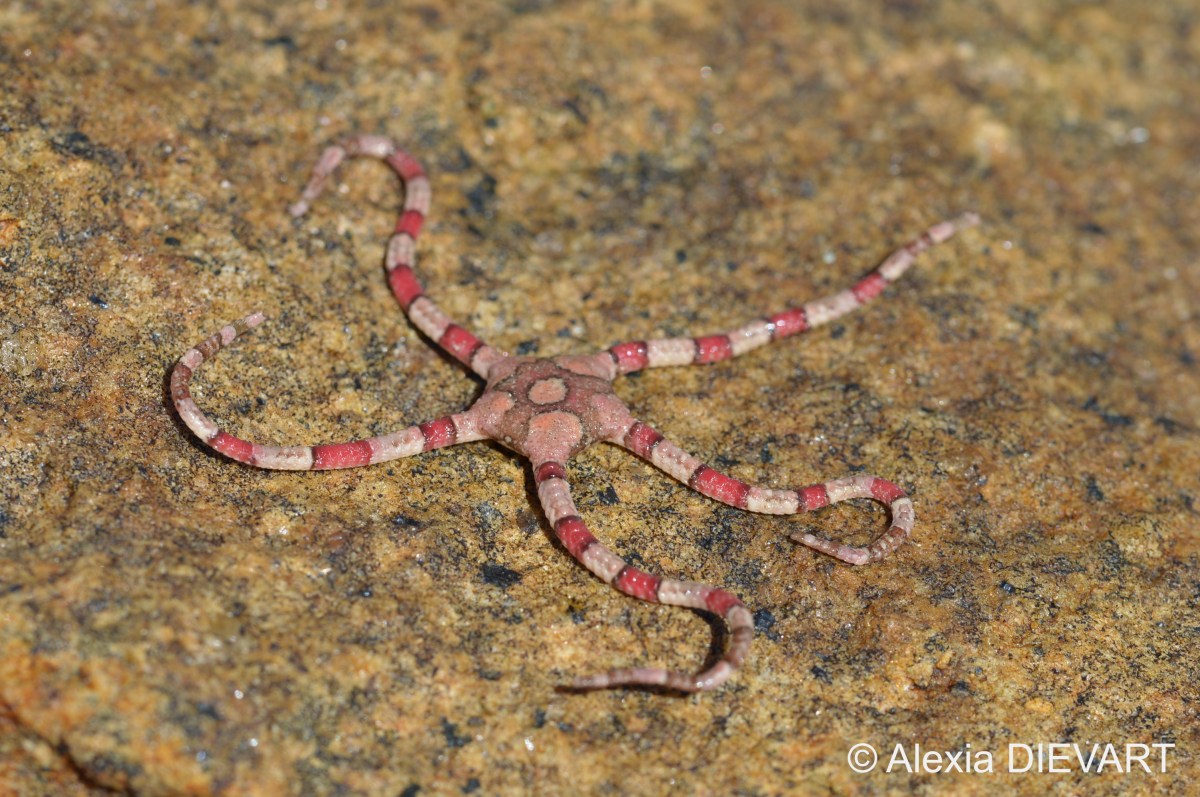
Brittlestars have a flat, circular body (called the ‘disc’), with five ore more long thin arms. The arms are jointed and flexible, but break off easily, hence the name ‘brittlestars’. The segments of the arms are each covered by 1 to 3 tiny plates, and their shape and number help distinguish between species. The sides of the arms often have spines. Brittlestars move by snake-like undulation of their legs. The mouth lies on the lower surface of the body and is surrounded by five toothed jaws. The texture of the disc allows to divide brittlestars into three groups: those with (1) granules, (2) short spines, or (3) a leathery or scaly texture. Just above the origin of each arm, there are usually two enlarged scales called radial shields.
Most brittlestars have minute planktonic larvae, but a few brood their young in their bodies and give birth to miniature replicas of themselves.
There are 120 species in southern Africa, but only about a dozen are common.
 F*CK FISH