
Crabs belong to the infraorder Brachyura – literally meaning short tail in Greek – and typically have a very short projecting tail-like abdomen, often hidden entirely under the thorax. There is about 850 species of freshwater crabs worldwide. The southern African fauna comprises 25 described species, all in the genus Potamonautes.
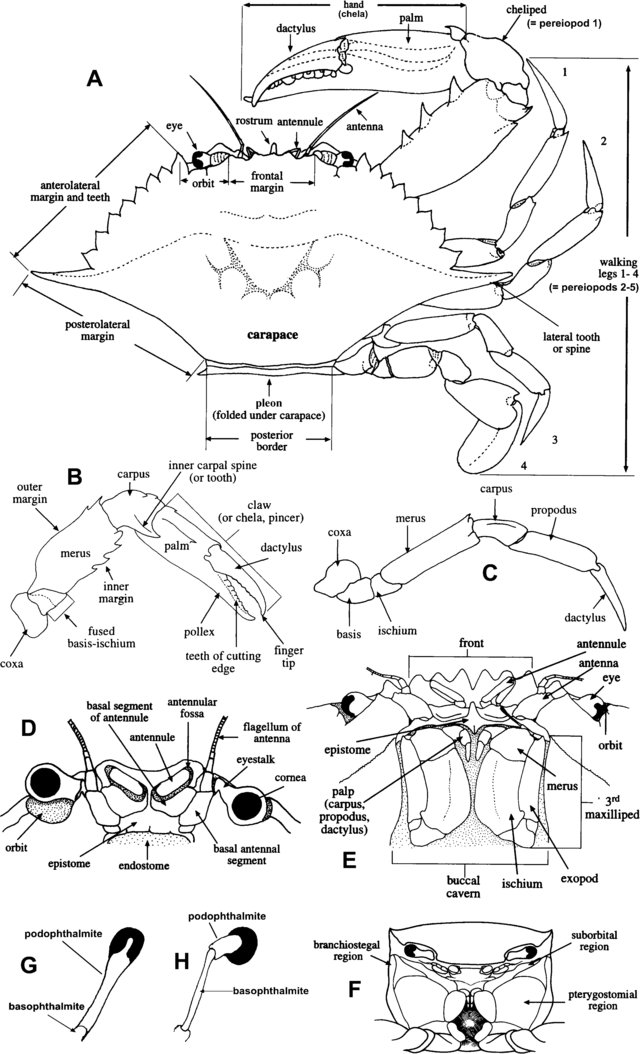
Morphology
With their short, rectangular and flattened bodies, crabs are covered by a hard ‘shell’ or carapace. Their carapace is a thick exoskeleton composed primarily of highly mineralized chitin. Their abdomen is reduced and folded under the body : male crabs have a narrow triangular abdomen, while female crabs have a broad semi-circular one. They have one pair of stalked eyes and five pairs of walking legs, with the first pair being modified to form sturdy pincers or chelipeds.
Food Cycle
Crabs are mostly omnivorous and will readily eat decaying plants and animal matter. They are very important prey items in the diets of birds, fish and otters, but can also be the vectors for diseases, such as lung flukes and river blindness in humans.
Reproduction
Large yolk-rich eggs develop under the abdomen of females and hatch into juvenile crabs, without a dispersive larval stage.
Distribution
Crabs can be found in all the world’s oceans, in freshwater ecosystems, and on land. Freshwater crabs may disperse overland between water bodies, but depend on freshwater for reproduction. Crabs breathe through gills located on their underside. These gills must be at least moist to work.
 F*CK FISH