
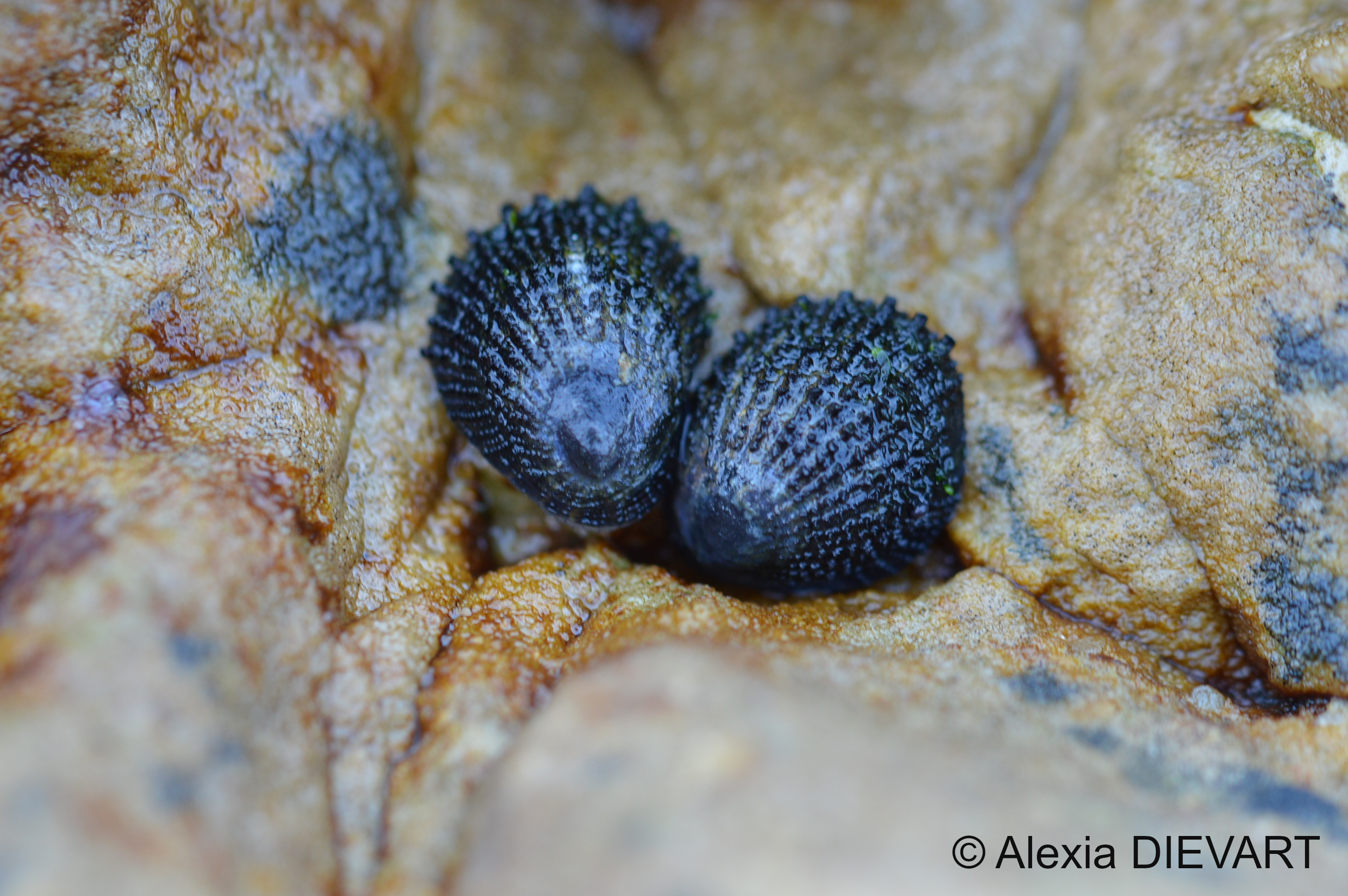
Shell tall, oval in outline, apex positioned very close to the anterior end, dark brown in colour with about 26 black ribs that are distinctively prickled.
About 30 mm.
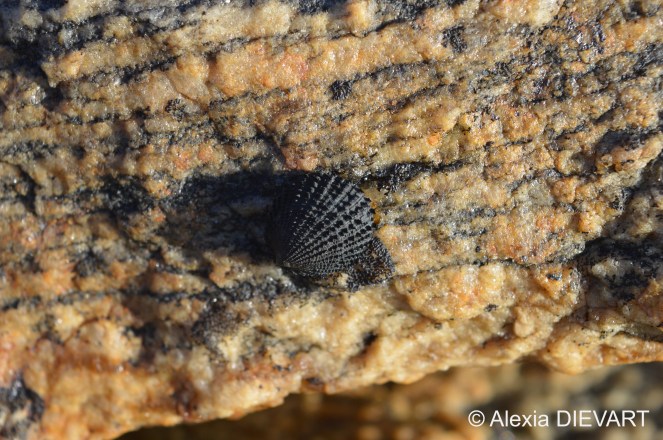
Lives very high on the shore, concealed in crevices or beneath boulders.
Two Oceans: A Guide to the Marine Life of Southern Africa (1994, 2016)

Habitat & Thermal Adaptations
Helcion pectunculus is one of the most abundant limpet grazers in the upper intertidal of marine South African rocky shores. During high tides and diurnal low tides, this limpet retreats to crevices and under boulders in the upper balanoid zone (Gray &Hodgson, 1998). Limpets within crevice refuges experience a more stable and buffered environment compared with that outside the crevice (Gray & Hodgson, 2004).
Gray & Hodgson (2004) observed that the smallest individuals – the youngest – were found at the rear of the crevice, while limpets were progressively larger – older – towards the front of the crevice, with the largest – oldest – of all in the ‘outer row’. This suggests that the rear of a crevice is a site of juvenile settlement. Small limpets not only begin foraging once the larger limpets have left the crevice, but they return to the crevice first.
A limpet’s age can be calculated thanks to its shell length, using species-specific growth equations – from Gray (1996) in this instance : the smallest limpets found within crevices where about seven months old (~ 10.4 mm in shell length), while the largest limpets were three years old (~ 27 mm in shell length). As limpets grow, they must migrate towards the mouth of the crevice due to the spatial constraint imposed by the shape of the crevice (Gray & Hodgson, 2004).
but After their daily food foraging excursions, Helcion pectunculus returns to a fixed ‘home scar‘ to which they fit exactly, ensuring a strong seal and securing them to the wave-battered surface of the rocks. Another thermal adaptation of the prickly limpet to reduce thermal stress is to be active during nocturnal low tides, and sticking to the shade during diurnal low tides (Gray &Hodgson, 1998).
REFERENCES

Gray, D.R., 1997. Studies of the biology and ecology of the high shore South African limpet, Helcion pectunculus (Mollusca : Patellogastropoda) (PhD Thesis). Rhodes University, Grahamstown, South Africa.
Gray, D.R., Hodgson, A.N., 2004. The importance of a crevice environment to the limpet Helcion pectunculus (Patellidae). Journal Molluscan Studies 70, 67–72. https://doi.org/10.1093/mollus/70.1.67
Gray, D.R., Hodgson, A.N., 1998. Foraging and homing behaviour in the high-shore, crevice-dwelling limpet Helcion pectunculus (Prosobranchia: Patellidae). Marine Biology 132, 283–294. https://doi.org/10.1007/s002270050394

 F*CK FISH